NFDI consortium

Home » About » NFDI consortium

We help researchers work with bioimage data by making it easier to store, share, and reuse images from microscopy and image analysis. Our work is part of the National Research Data Infrastructure (NFDI), a nationwide initiative that supports research data management across all disciplines.

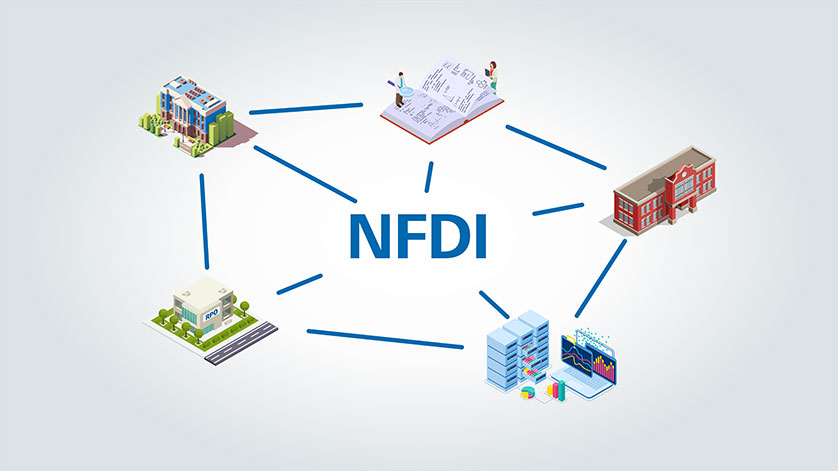
NFDI Network Infrastructure

What is the NFDI?

The National Research Data Infrastructure (NFDI) is a nationwide initiative that supports research data management. It is funded by the Federal Ministry for Research, Technology, and Space (BMFTR) together with the federal states. NFDI’s goal is to treat data as a shared resource for excellent research, organised by the scientific community. The work is carried out in collaborative groups called consortia.

More information about the NFDI and its consortia is available on the NFDI Association’s website.

What is a consortium?

A consortium is a collaborative network of institutions and researchers who work together on a specific research data domain within the NFDI. NFDI4BIOIMAGE is one of 26 NFDI consortia, alongside the cross-consortium project Base4NFDI, which provides basic services for all consortia. Together, these consortia cover a wide range of disciplines, from the humanities and social sciences to engineering and the natural and life sciences. All consortia were selected and funded through a scientific review process coordinated by the German Research Foundation (DFG).

What is NFDI4BIOIMAGE?

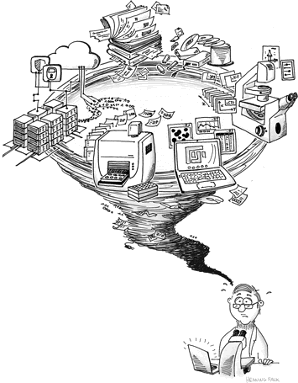
NFDI4BIOIMAGE stands for National Research Data Infrastructure for Bioimaging Data (Microscopy and Image Analysis). It is a community-driven project, developed by researchers for researchers. The consortium creates practical solutions that help the bioimaging community handle, store, share, and reuse image data in line with the FAIR principles. It also builds a strong data network and promotes best practices in bioimage data management nationally and internationally. All partners collaborate to achieve the goals of our work programme, and the involved institutions have distinct roles in the consortium.

© Henning Falk

What does FAIR mean?

FAIR principles describe how research data should be handled so that they are easier to use and reuse.

Findable

Data and metadata are easy to discover through search engines and repositories and have persistent identifiers.

Accessible

Data can be retrieved using standard protocols, with clear information on how they can be accessed.

Interoperable

Data use standard formats, vocabularies and metadata so they can be combined with other datasets and tools.

Reusable

Data are well described, clearly licensed and documented so they can be reused in future research.

Our goals

  • Standardised image data formats
    Harmonised file formats for biological imaging to ensure long-term usability and compatibility across tools and platforms.
  • FAIR Digital Objects for imaging data
    Next-generation, cloud-ready file formats that support scalable access, processing and reuse of image data.
  • Improved metadata and annotation standards
    Clear, consistent metadata models and user-friendly annotation tools to enhance data description and quality.
  • Reproducible image analysis workflows
    Transparent and well-documented analysis processes that can be reliably repeated and validated.
  • Interlinked image analysis tools
    Better integration of commonly used analysis software to enable seamless documentation and workflow tracking.
  • Multimodal data integration
    Linking image data with other data types from diverse experimental approaches and scientific disciplines.
  • Training and capacity building
    Education and training across disciplines to build expertise in biological image data management.
  • International networking and visibility
    Strong connections and recognition of NFDI within the global microscopy and imaging community.

Section work

Sections are legally dependent departments within the National Research Data Infrastructure (NFDI e.V.) that address topics affecting multiple consortia. They focus on cross-cutting issues, such as standards, policies, and best practices, that are relevant to more than one research domain. By coordinating these overarching topics, Sections help ensure consistency and collaboration across the entire NFDI landscape.