
NFDI4BIOIMAGE News
27.03.2025
Results from the 2024 OME-NGFF Hackathon
From November 18th to 22nd, the OME-NGFF Hackathon, organized by the BioVisionCenter at the University of Zürich with contribution and co-organization from NFDI4BIOMAGE has significantly boosted the power of OME-Zarr, the implementation of a cloud-ready file format for bioimaging data. Read this Hackathon report to learn about these advancements.
OME-Zarr is a specialized implementation of OME-NGFF (OME Next-Generation File Format) designed for bioimaging applications. OME-NGFF is a community-driven specification that defines how file formats—or rather, standardized object handling protocols—should be structured to enable efficient, high-performance processing of large-scale bioimaging data in cloud environments. Modern, advanced microscopes generate vast amounts of data, often ranging from hundreds of gigabytes to terabytes. These data store pixel intensity values that represent the light detected by the microscope at specific points within an image plane. With numerous image planes, multiple light channels (e.g., corresponding to different fluorescent dyes), and potentially time-lapse series, such data contain many dimensions. We refer to these as large N-dimensional arrays. Average computers fail to load such large data into memory, and sharing such large data is impeded because data transfer and loading takes very long.
The Zarr technology enables researchers to access only the desired individual areas of large images that are currently required for inspection or analysis. It does so by offering a strategy to break down a large file with binary information into a large number of small files—or rather, objects—systematically organized using metadata files in JSON format. The bioimaging community has leveraged this technology to develop OME-Zarr.
OME-Zarr is being developed as an open-source project, fostering collaboration within a large, international community. To ensure structured organization and consensus on specifications and implementations, the project employs a Request for Comments (RFC) process. This approach facilitates the introduction of innovations, adaptations, and necessary updates in a coordinated manner. Hackathons have proven to be an effective and engaging method to accelerate development and foster collaboration.
In November 2024, the OME-NGFF Hackathon took place at the BioVisionCenter of the University of Zürich. Organized by Joel Lüthi with support from a broad range of partners, including NFDI4BIOIMAGE—primarily through German BioImaging—this event yielded significant outcomes. The results not only highlight the achievements of the participating developers but also serve as a valuable resource for understanding the current state of OME-Zarr.
Find the original Preprint publication here:
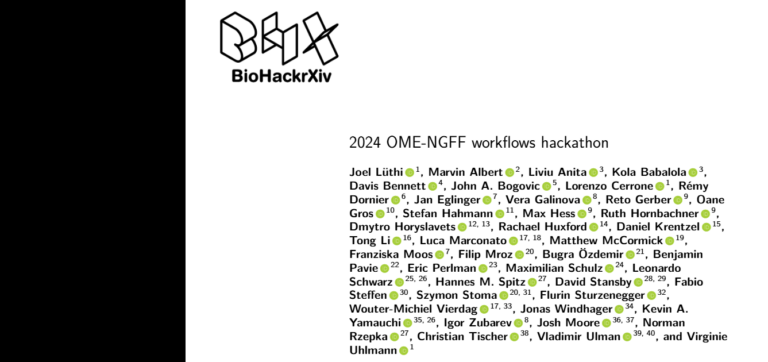
Joel Lüthi, Marvin Albert, Liviu Anita, Kola Babalola, Davis Bennett, John A. Bogovic, Lorenzo Cerrone, et al. (2025): 2024 OME-NGFF workflows hackathon, BioHackrXiv, https://doi.org/10.37044/osf.io/5uhwz_v1
Post by Joel Lüthi on BlueSky: https://bsky.app/profile/joelluethi.bsky.social/post/3lk3zc2g2bc2z