
NFDI4BIOIMAGE News
06.03.2025
Have you ever wondered if you could access a 100+GB dataset on your mobile device?
OME-Zarr is the bioimaging-specific implementation of the OME-NGFF specification. In other words: A potent, cloud-compatible file format for large N-dimensional array-typed data such as bioimaging data. Watch this video to see the power of OME-Zarr, making it possible to explore a dataset of more than 100 GB in size simply through a web browser. It even works from your mobile phone!
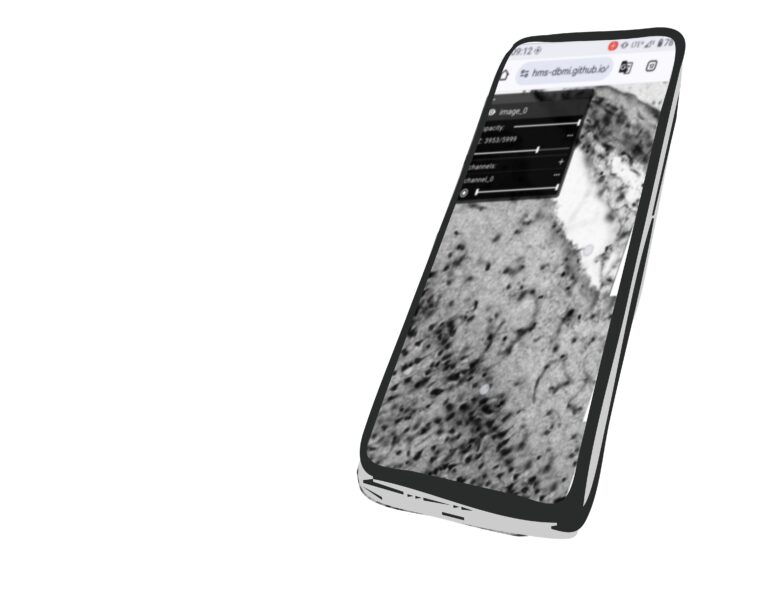
Opening large bioimaging datasets – ranging from gigabytes to terabytes in size – poses a significant challenge due to the inherent limitations of traditional file formats used in microscopy. These monolithic file structures require the loading of entire image planes, even when only a small region of interest is needed. As a result, data retrieval can be slow, and in some cases, the images may fail to load due to memory constraints. Such file formats hinder the efficient sharing and accessibility of large-scale bioimaging data in alignment with the FAIR principles (Findability, Accessibility, Interoperability, and Reusability).
OME-Zarr is a next-generation file format implementation designed to address these challenges. By segmenting large, multi-dimensional images into small, independently accessible chunks, OME-Zarr enables seamless data retrieval. Stored in cloud environments, these datasets can be accessed efficiently via web browsers, allowing researchers to stream only the required portions of the data rather than downloading entire files.
Recently, Zarr-Python 3.0.0 was released as the reference implementation supporting the latest Zarr v3 specification. This update played a pivotal role in the 2024 OME-NGFF Challenge, which facilitated the collection and rigorous evaluation of more than 500 terabytes of real-world bioimaging datasets stored in distributed cloud environments. These developments mark a significant step forward in establishing OME-Zarr as a community-driven, cloud-ready standard for bioimaging data.
If you’ve ever wondered whether accessing 100+ gigabyte images from a mobile device could be possible, the answer is yes – this future is now a reality.
(video music by Liborio Conti, royalty-free license, downloaded from www.no-copyright-music.com)