NFDI4BIOIMAGE News
18.06.2025
MeetOurDataStewards social media campaign started: Ksenia Kroos
Our Data Stewards are central to NFDI4BIOIMAGE’s Community Support. Get to know them! Our public relations team is launching the #MeetOurDataSteward series on social media to introduce our Data Stewards one by one. The campaign is kicked off with the introduction of Dr. Ksenia Krooß, NFDI4BIOIMAGE Data Steward at the Heinrich Heine University.
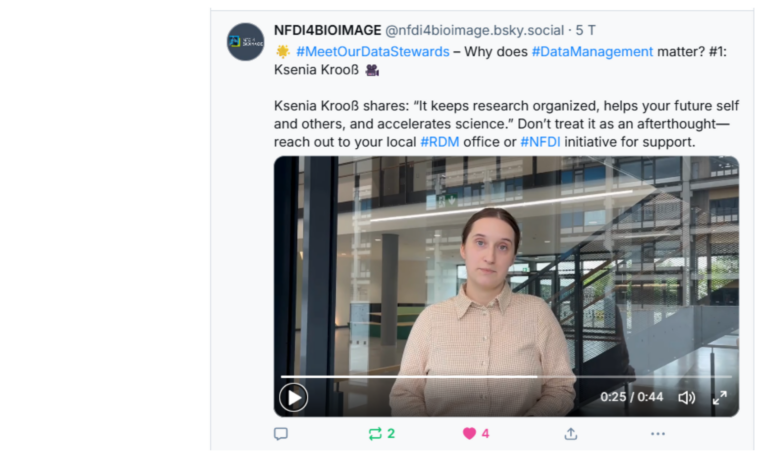
Bioimaging research data management can pose significant challenges. As a researcher working, for example, on your PhD or PostDoc project, it might feel like it adds a lot to your workload at first. But not only is a robust RDM strategy a huge and workload-alleviating asset for your work, you’re also not left alone to do it. NFDI4BIOIMAGE’s Data Stewardship Team comprises scientists and software engineers who have specialized in bioimaging data management, drawing on their experience in conducting scientific research. Let’s start by introducing Ksenia Krooß to you. Ksenia is working at the Center for Advanced Imaging (CAi) of the Heinrich Heine University Düsseldorf. She is an experienced plant biologist and microscopist who is dedicated to supporting the community with bioimaging RDM.
Ksenia Krooß: “Before I began working as a Data Steward, I had already encountered the challenges of data publication firsthand. In the context of two of my paper publications, I needed to upload imaging data to a public repository. At the time, I was unfamiliar with many of the terms, metadata requirements, and submission procedures involved in the process. The experience was overwhelming; I felt alone and under immense pressure to get everything right. Looking back, I wish I had known that there were people I could have reached out to for support.
Once I started my position as a Data Steward, one of the first requests I received came from my former colleague, now a current one, Inga. She needed help uploading her imaging data in connection with her new publication. By then, I had gained a solid understanding of key concepts such as data organization, metadata standards, and the REMBI (Recommended Metadata for Biological Images) (https://www.nature.com/articles/s41592-021-01166-8) annotation guidelines. This request sparked a realization: I wanted to ensure that other researchers wouldn’t have to struggle with the data submission process the way I once did.
Simply pointing someone to a suitable repository and sending them a link to read through the submission prerequisites is not enough. While many repositories provide extensive documentation, this abundance of information can be just as confusing as helpful, especially to someone encountering it for the first time. As a Data Steward, my role is not just to inform, but to guide and support. I saw myself as a facilitator who removes the friction from the process, ensuring that researchers don’t feel like they have to face it alone.
Before meeting with Inga, I developed a structured approach – a personal guideline for assisting with data submissions. I started by asking essential questions to understand the scope of her research: What was the study about? What were its components? Which imaging techniques, organisms, treatments, and analyses were used? With this information, I could identify the most suitable repository for her data, in this case, BioImage Archive (https://www.ebi.ac.uk/bioimage-archive/).
During our initial meeting, I walked Inga through how BioImage Archive works: its structure, the design of its submission form, and what she should expect. I also introduced her to REMBI at this stage, aiming to make the metadata collection process less abstract and more comprehensible. I explained that her study would need to be broken down into Study Components, a requirement for BioImage Archive. Importantly, I clarified that these Study Components may not align with the figures in her paper, something many researchers intuitively default to when organizing data for publication.
After our conversation, I provided Inga with two documents: the first was a concise summary of everything we discussed, and the second was a table template that reflected the fields and information required during the actual submission. This helped her organize her data in a clear and structured way before taking the next steps.
Once Inga had prepared her data, we held a second meeting. I reviewed how she had organized her data into Study Components and examined the metadata she had compiled. By this point, most of the preparatory work was complete. The final task involved creating the file lists required for each Study Component. I explained the formatting prerequisites for these lists, and Inga prepared them based on our discussion. In the final session, she uploaded her data to the repository, and shortly thereafter, her data (10.6019/S-BIAD1241) became publicly accessible alongside her paper.
This experience was incredibly formative for me. It was my first opportunity to guide someone through the entire data publication process, and it allowed me to refine the guideline I now use for similar requests. Over time, I have continued to adjust and optimize this approach depending on the specific needs of each researcher. Some require multiple meetings and hands-on support, while others feel confident enough to manage the rest independently after a single session. Regardless of the level of involvement, I make myself available throughout the process to answer questions and ensure everything runs smoothly.
I truly believe that the researchers who have worked with me had a much more seamless and less stressful data publication experience than if they had done it all on their own. As more scientific journals begin to mandate data publication alongside manuscript submissions, this process will become a common challenge faced by researchers across disciplines.
That’s why I hope that, as part of NFDI4BIOIMAGE, we can raise awareness and let researchers know: you don’t have to navigate this alone – we’re here to help!”