Our work program

Home » About » Work program

Data Life Cycle and Objectives

Our consortium works towards four main goals: advancing standards for bioimage data, providing scalable infrastructure for FAIR bioimage data, supporting reproducible image analysis workflows, and empowering researchers in FAIR bioimage data management.

To fulfill these goals, our work program is organized  in six Task Areas. As the NFDI4BIOIMAGE consortium is a bottom-up project from the communtiy for the community, close collaboration of our members and participating institutions is inevitable. All our activities are dedicated to improving the capabilities and the capacity for bioimaging research data management in the scientific community. Find our partners here.

Task Areas

We are organised into six Task Areas. Four Task Areas focus on developing and improving technical solutions for bioimage data management. Two Task Areas address coordination and governance, with a strong emphasis on community engagement, training, and support for researchers.

Each Task Area is led by two or three experts from our partner institutions. The full work programme is described in the NFDI4BIOIMAGE proposal, which is available on Zenodo.

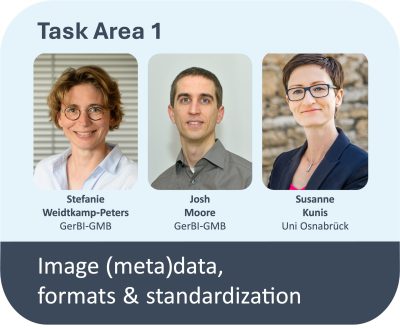
Task Area 1: Image (meta)data, Formats and Standardization

Key words: OME.zarr – NGFF – FAIR-IO (an FDO concept) – JSON-LD – RDF – OME.OWL

In Task Area 1, the harmonisation and further development of image data formats and metadata standards is a key focus. Standardised formats are essential to ensure interoperability across different data types and data management systems. This requires annotations that are both machine-actionable and easy for humans to understand.

An important recent international effort within the bioimaging community is the development of next-generation file formats (NGFF) for imaging data, to which we actively contribute. NGFFs are promising candidates for globally harmonised image formats and, among other advantages, support cloud-based handling of large-scale image data. As a result, this topic has strong potential to become a cross-cutting activity within the NFDI.

The current next-generation file format for bioimaging data is OME-Zarr. OME-Zarr enables efficient, random access to multi-dimensional image data, allowing users to access individual planes or views without loading entire datasets. It also supports streaming of image data over the Internet, so that only the required data are transferred. The ecosystem of tools for OME-Zarr-based visualisation and image analysis is growing steadily. OME-Zarr is a central pillar of the NFDI4BIOIMAGE FAIR-IO concept (FAIR Image Objects). FAIR-IO implements the principles of FAIR Digital Objects (FDO) for bioimaging by combining image data with associated digital assets, rich metadata, and unique identifiers. This structure enables linked data approaches and ensures long-term machine-readability and reuse.

Stefanie Weidtkamp-Peters
Josh Moore
Josh Moore
Susanne Kunis
Susanne Kunis
  • Moore, Josh, Kunis, Susanne. Zarr – A Cloud-Optimized Storage for Interactive Access of Large Arrays, Vol. 1 (2023): 1st Conference on Research Data Infrastructure (CoRDI) – Connecting Communities. Link to source. Find conference proceedings here. Scholarly work can be found here.
  • Moore, Josh; Waagmeester, Andra; Hettne, Kristina; Wolstencroft, Katherine; Kunis, Susanne (2024): „RDF as a bridge to domain-platforms like OMERO, or There and back again.“ Link to source.
  • Moore, Josh; Kunis, Susanne (2024): „AI’s Dirty Little Secret: Without FAIR Data, It’s Just Fancy Math“. Link to source.
  • Moore, J., Basurto-Lozada, D., Besson, S. et al. OME-Zarr: a cloud-optimized bioimaging file format with international community support. Link to source.
  • Moore, Joshua Allen. (2023). Zarr: A Cloud-Optimized Storage for Interactive Access of Large Arrays. 1st Conference on Research Data Infrastructure (CoRDI), Karlsruhe, Germany. Link to source. Find the conference poster here. Scholarly work can be found here.
  • Brooks, Michael. (2023). How open-source software could finally get the world’s microscopes speaking the same language. Link to source.
  • Moore J, Allan C, Besson S, et al (2021) OME-NGFF: a next-generation file format for expanding bioimaging data-access strategies. Link to source.
  • Moore, J. A., & Kunis, S. (2023). NFDI4BIOIMAGE: Perspective for a national bioimage standard. Link to source. Find the conference poster here. Scholarly work can be found here.
  • Moore, J., Kunis, S., Grüning, B., Blank-Burian, M., Mallm, J.-P., Stöter, T., Zuschratter, W., Figge, M. T., Kreshuk, A., Tischer, C., Haase, R., Zobel, T., Bauer, P., Svensson, C.-M., Gerst, R., Hanne, J., Schmidt, C., Becker, M. M., Bocklitz, T., … Weidtkamp-Peters, S. (2024). NFDI4BIOIMAGE – National Research Data Infrastructure for Microscopy and Bioimage Analysis. Link to source.​​​​​​​

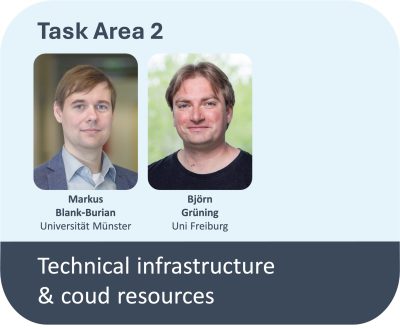
Task Area 2: Technical Infrastructure and Cloud Resources

Key words: Infrastructure as a Service (IaaS) – Desktop as a Service (DaaS) – Training – Infrastructure as a Service (TIaaS) – Jupyter – Pulsar – Galaxy – OMERO

Task Area 2 provides technical infrastructure and cloud resources and serves as a central enabler for the consortium and the community, including “sandbox” environments for testing of new tools and services. They also provide access to image analysis workflows that require high computational resources in collaboration with TA4.

People19
Björn Grüning
People18
Markus Blank-Burian

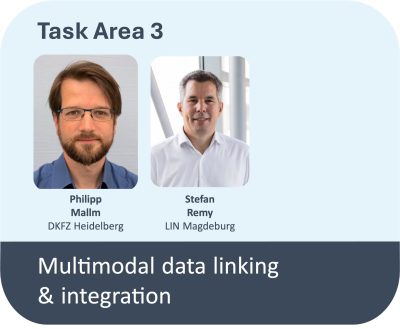
Task Area 3: Multimodal data linking and integration

Key words: Interoperability – Multimodal graph database – Spatial omics technologies – Sample (metadata) tracking

Task Area 3 focuses on linking bioimage data with other data types and connecting image-specific data management systems to more general research data infrastructures. It also includes targeted collaborations with other consortia to develop and align shared data structures.

Jan-Philipp Mallm
Philipp Mallm
People23
Stefan Remy

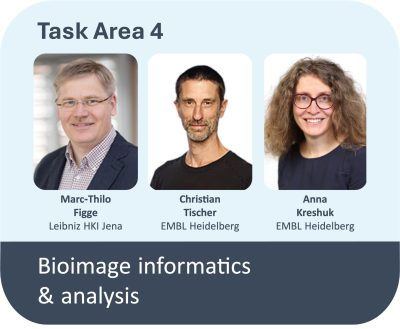
Task Area 4: Bioimage Informatics and Analysis

Key words: Reproducible analysis workflows – JiPipe – Fiji/ImageJ – Bioimage analysis desktop (BAND) – Galaxy – Jupyter Notebooks

Task Area 4 promotes reproducible bioimage analysis workflows by improving interoperability between widely used tools. In close collaboration with Task Area 2, they also work to make state-of-the-art analysis methods accessible to the entire bioimaging community. Together with Task Area 5, Task Area 4 contributes to training materials that support the effective use of new and advanced analysis approaches.

People20
Marc-Thilo Figge
Christian Tischer
Christian Tischer
People21
Anna Kreshuk

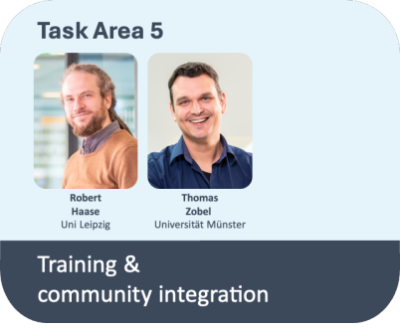
Task Area 5: Training and Community Integration

Key words: Community Engagement and activation – Data stewardship – Workshops and training events – Teaching material cross-site search index
 
Task Area 5 focuses on training and community engagement by providing access to a cross-platform database of resources and organising in-person events. It also develops training materials for the tools and services offered by the other Task Areas. The Data Steward team, led by Task Area 5, supports the community at all levels. Reach our Data Stewards via the Help Desk!
Robert Haase
Robert Haase
TZ_neu
Thomas Zobel

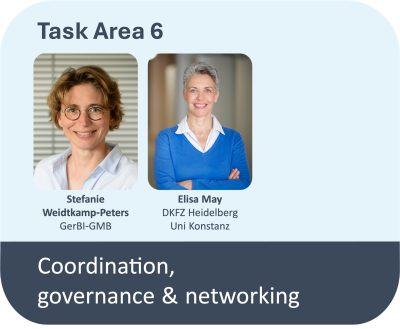
Task Area 6: Coordination, Governance, and Networking

Key words: National and international networking – Administration and organization – Evaluation and reporting – Strategy and monitoring – Outreach and public representation – Coordination of the work in Sections and cross-cutting topics in the NFDI association

Task Area 6 oversees the overall coordination and management of the project. It is responsible for executive project management, as well as outreach and networking activities that connect the consortium with the wider research community. Task Area 6 also hosts the NFDI4BIOIMAGE Coordination Office, which serves as the central hub for communication, organisation, and support across all Task Areas.

Stefanie Weidtkamp-Peters
Elisa May
Elisa May

Our members

All members, who are co-applicants, share the main responsibilities for the work programme by leading one or more task areas in the work programme. The scientists leading a Task Area have the role as co-spokespersons of the consortium and responsibly represent their institutional contribution within NFDI4BIOIMAGE. Co-Applicant institutions receive funding from the consortium’s budget.

The Heinrich-Heine University Düsseldorf (HHU) is the main institution responsible for the NFDI4BIOIMAGE project at large. The consortium’s budget is administrated at HHU and transferred to other member institutions based on a Fund Transfer and Collaboration Agreement. The HHU’s responsible scientist for the consortium, Prof. Stefanie Weidtkamp-Peters, Head of the Center for Advanced Imaging (CAi) at HHU, acts as the Spokesperson of NFDI4BIOIMAGE

Heinrich Heine University Düsseldorf (HHU)


Responsible:

Prof. Dr. Stefanie Weidtkamp-Peters
Head of the Center for Advanced Imaging (CAi)
Spokesperson of NFDI4BIOIMAGE

German Cancer Research Center (DKFZ),
Heidelberg

Responsible:
Prof. Dr. Elisa May, Chief Enabling Technology Officer (CETO)

Dr. Jan-Philipp Mallm, Head of the Single-cell Open Lab

European Molecular Biology Laboratory (EMBL),
Heidelberg

Responsible:
Dr. Anna Kreshuk, Research Unit Cell Biology and Biophysics, Machine Learning for Bioimage Analysis

Dr. Christian Tischer, Team Lead BioImage Analysis

University Münster


Responsible:

Dr. Thomas Zobel, Head of the Münster Imaging Network

Dr. Markus Blank-Burian, Univerty Münster IT

University of Osnabrück (UOS)


Responsible:

Dr. Susanne Kunis, Integrated Bioimaging (iBiOs) at Center of Cellular Nanoanalytics (CellNanOs)

Leibniz Institute for Natural Product Research and Infection Biology,
Hans Knöll Institute (HKI), Jena

Responsible:
Prof. Dr. Marc Thilo Figge, Applied Systems Biology
Cluster of Excellence Balance of the Microverse

Leibniz Institute for Neurobiology (LIN),
Magdeburg


Responsible:

Prof. Dr. Stefan Remy, Scientific Managing Director

German BioImaging – Gesellschaft für Mikroskopie und Bildanalyse e.V. (GerBI-GMB)


Responsible:

Prof. Dr. Stefanie Weidtkamp-Peters, Head of Board
Josh Moore, Senior Research Data Management Officer

University of Konstanz (UKON)

Responsible:
Prof. Dr. Elisa May, Professor for Cellular Bioimaging
Chief Enabling Technology Officer at the DKFZ

University of Leipzig (UL)

Responsible:
Dr. Robert Haase, Training Coordinator at the Center for Scalable Data Analytics and Artificial Intelligence (ScaDS.AI)

University of Freiburg (ALU-FR)

Responsible:
Dr. Björn Grüning, Head of Freiburg Galaxy Team

Participating institutions

Many partners contribute regularly to the work in our Task Areas without being formally responsible for leading them. Each participating institution is represented by a project leader who coordinates its contribution to NFDI4BIOIMAGE. Participating institutions may receive funding from the consortium’s budget.

In addition to consortium members, we collaborate with consortium partners. These include international initiatives and projects, such as Euro-BioImaging ERIC or the BioImage Archive at EMBL-EBI, as well as Community Use Cases (CUCs). CUCs are stakeholders from the bioimaging community who test consortium tools and services in practice and provide feedback to improve them. All collaborations are based on mutual benefit. Consortium partners do not receive direct funding but may be supported through allocated person-hours to help achieve shared goals.

Forschungszentrum Jülich


Responsible:
Prof. Dr. Timo Dickscheid
Working Group Leader „Big Data Analytics“

Georg-August-University of Göttingen


Responsible:
Prof. Dr. Jan Huisken
Head of the Multiscale Biology lab

HAWK University of Applied Sciences and Art Hildesheim/Holzminden/Göttingen

Responsible:
Prof. Dr. Claire Chalopin
Faculty of Engineering and Health

Heidelberg University


Responsible:
Prof. Dr. Jan Lohmann
Centre for Organismal Studies (COS) Heidelberg

Helmholtz-Center for Environmental Research – UFZ,
Leipzig

Responsible:
Dr. Jan Bumberger
Head of Research Data Management & Environmental Sensor and Information Systems

Johannes Gutenberg-University Mainz


Responsible:
Prof. Dr. Paul Czodrowski
Physical Chemistry with a focus on Experimental Biophysical Chemistry

Leibniz Institute for Analytical Sciences  – ISAS,
Dortmund

Responsible:
Dr. Jianxu Chen
Group Leader AMBIOM – Analysis of Microscopic BIOMedical Images

Leibniz Institute for Plasma Science and Technology – INP,
Greifswald

Responsible:
Dr. Markus Becker
Head of depertment Plasma Modelling and Data Science

Leibniz Institute of Photonic Technology – IPHT,
Jena

Responsible:
Prof. Dr. Thomas Bocklitz
Head of research department „Photonic Data Science“

Max Planck Institute for Evolutionary Biology – MPIEB,
Plön

Responsible:
Dr. Carsten Fortmann-Grote
Heaf of Scientific Computing Services Unit

Technical University of Dresden


Responsible:
Prof. Dr. Michael Schlierf
Head of B CUBE – Center for Molecular Bioengineering

University of Cologne


Responsible:
Dr. Astrid Schauss
Head of Imaging Facility CECAD

Participating persons

Dr. Jean-Marie Burel
Open Microscopy Environment Consortium, University of Dundee, UK

Our partners

The activities of NFDI4BIOIMAGE’s member institutes are integrated into the international bioimaging community through exchange and collaboration with organizations, and projects worldwide. We seek for international collaboration with interested communtiy stakeholders.

Is your project or organization missing? Contact us!