NFDI4BIOIMAGE News
17.09.2025
#Meet our Data Stewards: Vanessa Fuchs
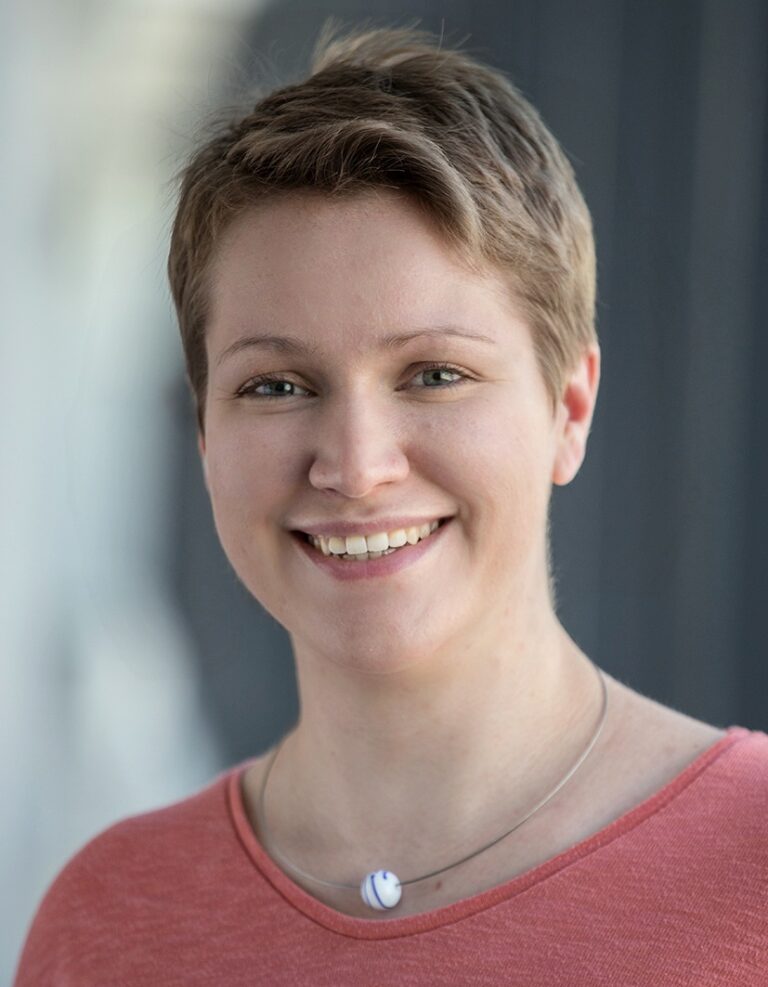
Our Data Stewards are central to NFDI4BIOIMAGE’s Community Support. Get to know them! In our social media campaign, “Meet the Data Stewards”, we introduce one member of our NFDI4BIOIMAGE Data Steward Team every month. This month, we are introducing Vanessa Fuchs, who works at the Center for Advanced Imaging (CAi) at Heinrich Heine University Düsseldorf.
From Hard Drives to OMERO: My Journey into Data Stewardship
Vanessa is an expert in data organisation and metadata annotation in OMERO. She offers valuable advice to keep in mind as we embark on our data management journey: “Seek support in data management. If you have the chance to get support, take it as early in your project as possible. Even if you are already very advanced in the project, it is never too late to start managing your data, especially if you have support.” You can receive this support from Vanessa and all the other data stewards in our team. In the following text, Vanessa talks about her first encounters with data management, the initial hurdles she faced, and how she achieved success with the help of AI and a lot of work:
When I left the lab after my PhD and PostDoc, I took with me two hard drives filled with all my imaging data. Not long after, my former PI asked me to make the data reusable so another researcher could reanalyse my time-lapse images. By that time, I had just started working as a data steward – and immediately saw the perfect training opportunity. Using my own data would not only help me learn OMERO, data organization, and annotation, but also give me the perspective of the researchers I would later support.
At first, the task felt overwhelming: several gigabytes, hundreds of files, and dozens of experimental conditions. Thankfully, all experiments were technically comparable, which made structuring slightly easier. I began by defining a set of tags, deciding which images belonged to which dataset, and even drafting a dummy-REMBI table. To make sense of everything, I mapped my old folder structures that I created in various stages of my research, and designed the streamlined structure required for an OMERO upload.
Without coding skills, reorganizing such a large dataset seemed like a roadblock. Here, AI became an unexpected ally. By carefully breaking down my problem and iterating with a large language model, I generated custom Jupyter notebooks that reorganized my files into a consistent folder structure with proper names, based on our naming convention. This step alone saved me endless hours of manual sorting.
Uploading to OMERO was still a multi-day effort, with tagging and annotation requiring focus and time. But thanks to the preparation, the process remained manageable. In the end, the data was accessible, annotated, and reusable and the collaborator, who was situated in the US, was able to seamlessly reanalyse it, even though the data was stored in Germany. That moment felt truly rewarding.
This experience taught me a valuable lesson I now pass on in my work in NFDI4BIOIMAGE and at the CAi: proper data management requires an upfront investment, but once the system is in place, adding new data becomes almost effortless. That is why, after users are trained on our microscopes, they immediately receive an OMERO introduction and annotation session. By catching researchers at the beginning of their projects, we set them up for efficient, transparent, and long-term data handling.
Seek for support in data management. And if you have the chance to get support, use it at the earliest possible time point in your project. But even if you are already very advanced in the project – it is never too late to do data management especially if you have support.
Don’t hesitate to reach out to our Data Stewards via the Help Desk.