
Explore our NFDI4BIOIMAGE calendar of the year 2024 with microscopy images from the life sciences
Each month we presented a new, wonderful microscopy image from the bioimaging community and the story behind it.
To make the image understandable for readers, we provided a set of original metadata for each image, and we explored challenges and ideas for making bioimage data FAIR (findable, accessible, interoperable, reusable).

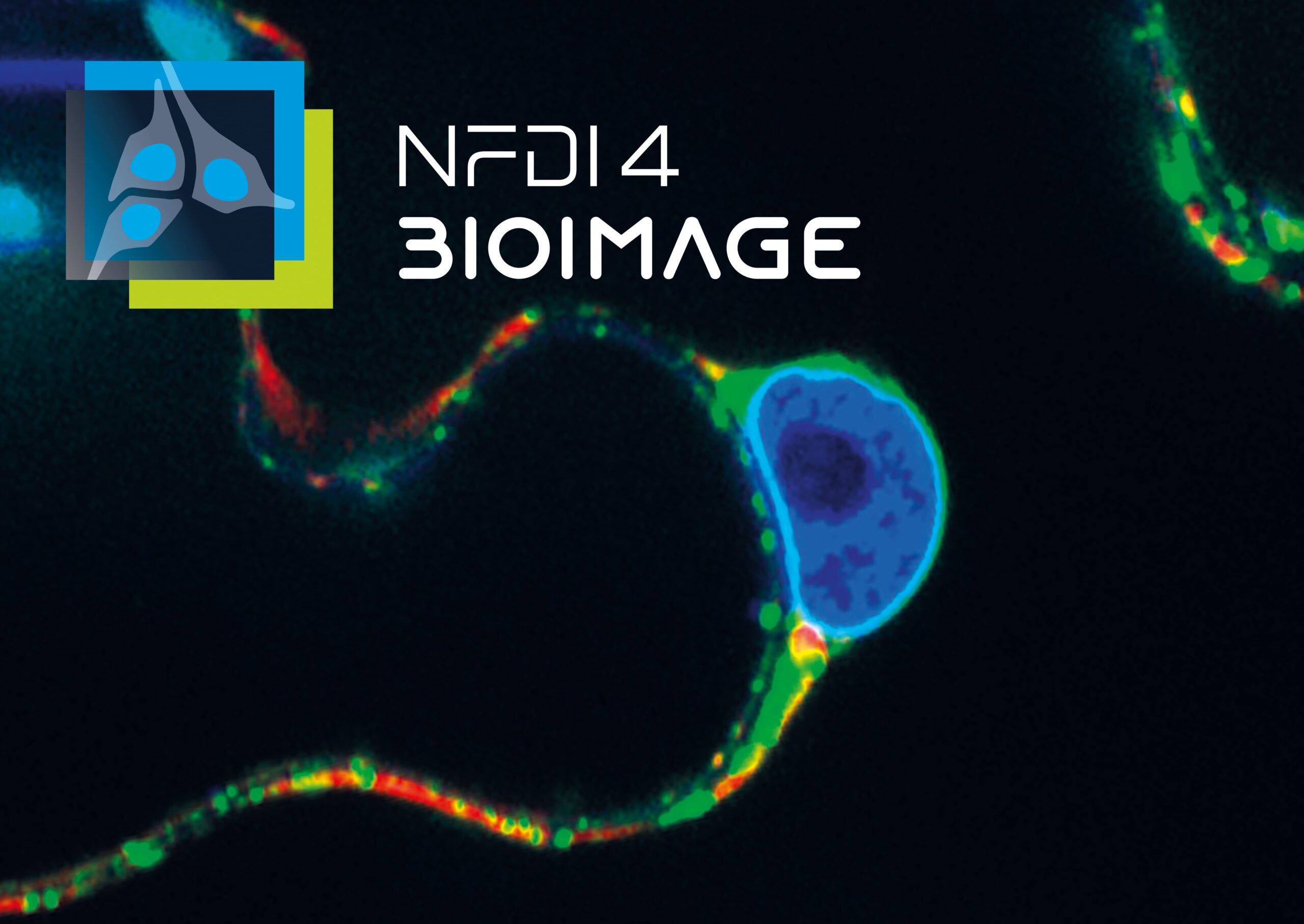
January 2024: Nicotiana benthamiana in beautiful colors
Our January-image was acquired during a microscopy course for master students in 2016 at the Heinrich-Heine University in Düsseldorf. It depicts pavement cells of Nicotiana benthamiana with multiple fluorescent markers, each corresponding to one cellular compartment. While a beautiful image, unfortunately its scientific value is limited, since information has been lost. Technical metadata can still be retrieved from the original image file, but the biological context of the sample is unknown since no metadata annotations were preserved. Specific information on the labelled proteins as well as the protocol for sample treatment and preparation prior to image acquisition are missing. Some of this context might still exist in old paper lab books, if they could be found, but retrieving them would take significant time and effort.
Consequently, this image will hardly become FAIR. Now, what does FAIR mean? FAIR is the acronym for ‘Findable, Accessible, Interoperable and Reusable’. For this image, I would say that it is certainly possible to make it findable and accessible, we could even make it interoperable to some degree, but it will be tough, if not impossible, to make it reusable. So, what could we do better? To conserve the scientific value of an image, proper and timely annotation of the (biological) metadata is necessary. Any information that is not written down or cannot be clearly assigned anymore 10 years from now is lost eventually. It is the key mission of the NFDI4BIOIMAGE consortium to enable researchers to make their data FAIR. For this, we aim to develop standards and provide technical solutions while our Data Stewards offer support to the bioimaging community.
So, I would like to propose a new year’s resolution for 2024: Let’s annotate all our images timely and carefully to make them FAIR and therefore preserve their scientific value for the future. Over the next months, NFDI4BIOIMAGE calendar pages will provide example images and experiences from across the FAIR spectrum. Stay tuned.
Happy New Year to everyone!
Vanessa, Data Steward in the NFDI4BIOIMAGE consortium

February 2024: The internal wiring of a cancer cell line
The February image was acquired in 2023 during a microscopy course for master students at the Center for Advanced imaging (CAi) at the Heinrich-Heine-University in Düsseldorf. It depicts two HEp2 cells, a cancer cell line used in many laboratories, which after fixation were stained with dyes and antibodies. In blue, you see the nucleus stained with DAPI, green represents the actin cytoskeleton, red depicts the mitochondria and intermediate filaments can be seen in white.
The image is beautiful, but we ask: Is it also FAIR1? The raw file is safely archived on a file server at CAi, but users who would like to examine or re-use the file would need to find the right location, successfully download and interpret the format in which it was written. To improve this situation, the file has also been imported into OMERO (Open Microscopy Environment Remote Object), a client-server software platform for visualizing, managing, and annotating scientific image data2. The data is still stored on a server within CAi but can be accessed from everywhere the user has internet access. In conclusion, the data is Findable and Accessible.
The data is also Interoperable: OMERO uses the Bio-Formats3 tool, a tool that is able to read many proprietary file formats from microscopy vendors, to read microscopic images during import. So even though, the original file is in a proprietary file format, it can either be read by another researcher using the Bio-Formats tool or it can be exported from OMERO using another, more interoperable file format.
The reusability of the image is defined by the amount of (biological) metadata that is attached to the image. The hardware metadata (which microscope was used, which objective, which filters etc.) is read by Bio-Formats during the import and is displayed in the OMERO interface. The biological metadata has to be added manually by the user, which can be done using the annotation tools in OMERO. Here we decided to add all relevant information using key-value pairs.
But how does the user decide which information is relevant and how to structure it? We decided to follow the REMBI (Recommended Metadata for Biological Images) guidelines published by Sarkens et al. in 2021. REMBI suggests categories for biological information (e.g. Study, Biosample, Specimen…) and includes the use of ontologies.
While metadata annotation seems laborious at first, it is an essential step to make biological images reusable. We think that taking the time to make sure your images are reusable and therefore FAIR is time invested in the future: of your work (when preparing for publication eventually), of the image itself and also of the scientific community that might reuse your image to answer yet another scientific question.
Vanessa, Data Steward in the NFDI4BIOIMAGE consortium and at CAi
1: FAIR = Findable, Accessible, Interoperable, Reusable
2: https://omero.readthedocs.io/en/stable/users/index.html
3: https://www.openmicroscopy.org/bio-formats/
4: Sarkans, U., Chiu, W., Collinson, L. et al. REMBI: Recommended Metadata for Biological Images—enabling reuse of microscopy data in biology. Nat Methods 18, 1418–1422 (2021). https://doi.org/10.1038/s41592-021-01166-8
[3] Varela-Jaramillo, A., Rivas-Torres, G., Guayasamin, J. M., Steinfartz, S., & MacLeod, A. (2023). A pilot study to estimate the population size of endangered Galápagos marine iguanas using drones. Frontiers in Zoology, 20(1), 4. https://doi.org/10.1186/s12983-022-00478-5

March 2024: Dinner for Whom?
This month’s image depicts a section of the posterior end of a Drosophila melanogaster’s midgut in a transmission electron microscopy micrograph, with an artificially colored overlay of the nucleus (blue), nucleolus (purple), and mitochondria (green) resulting from an artificial-intelligence assisted segmentation. The image was imported into OMERO, a software platform for visualizing, managing, and annotating metadata of scientific images, and loaded straight into QuPath via an OMERO plugin, where the SegmentAnythingModel (SAM) was set up for segmentation. From box inputs, SAM detected the regions of interest (ROI) that we uploaded back to OMERO as annotation of the original image, waiting for further review, analysis or montage. Via OMERO, the image can be made FAIR (What is FAIR? See January and February 2024).
But what goes beyond FAIR? When acquiring any type of data, it is desirable to comply with the FAIR principles to make data reusable. However, it is equally important to make the (meta)data “fit for purpose.” In other words, while following these principles to make your (meta)data FAIR, you should also think about who should be able to reuse the data. Because from the user’s perspective, the quality of (meta)data is context-dependent. It can be of high quality in one context and of (relatively) poor quality in another. Let’s go back to our image from this month: what is the scientific context of our image, and what would be the purpose of reusing it? Technically improve a microscopic method? – In this case, the focus of the metadata description would be on the technical part of the image capture. Or is it to find out what our Drosophila melanogaster ate for dinner? – In this case, the metadata description would focus on the examined object and the experimental conditions.
In our consortium, we are working on solutions and workflows to make this seemingly tedious metadata annotation as simple and automated as possible and to make your data FAIR and fit for multiple purposes. This includes the automated import of multimodal and harmonized metadata, the conversion of proprietary data formats into a universal data format, and the provision of the technical infrastructure.
Keep following us for more!
Maximilian E. Müller, Data Steward in the NFDI4BIOIMAGE consortium (Team Open Science, KIM, University of Konstanz)

April 2024: A FAIRy tale of meiosis
The image of the month April was kindly contributed by Nadja Rotte who explored the genetics of male infertility as a PhD student in the group of Corinna Friedrich at the Institute of Reproductive Biology at Münster University. This spread of an entire set of condensed chromosomes of a single human spermatocytic cell in meiosis illustrates a perfect cellular analogy of the FAIR principles. Let’s explore how nature implements the principles of findability, accessibility, interoperability and reusability.
The nearly perfectly assembled homologous chromosome threads, made visible by the cell biological technique of chromosome spreading, seem rather unsorted at first glance. However, the high resolution of the image acquired by structured illumination microscopy (SIM) illustrates chromosome-associated proteins and highlights the enormous extent of organisation particularly between homologs. This makes chromosomal regions FINDABLE for researchers but also intracellular players. Despite largely silenced gene expression at this stage of meiosis, essential genes remain ACCESSIBLE for the transcription machinery. This interplay follows clear concepts with fine-tuned quality control mechanisms.
Functional units highlighted by fluorescence based on antibody staining of protein complexes essential for cohesion of chromosomes and recombination are INTEROPERABLE with each other. Genetic material is naturally REUSABLE for cellular progeny and during meiosis minor derivatives are intentionally generated.
Nadja and her colleagues implement FAIR principles by using OMERO at the Multiscale Imaging Centre (MIC). They discuss reseach results based on summaries of microscopy images created using OMERO.figure and can easily share their findings with the scientific community. “For us, OMERO is becoming a valuable tool for organising and visualising our microscopy data. Especially the option to directly link URLs to the web-based image viewer greatly improves the accessibility and impact of our research findings. We are excited to include this feature in our upcoming publication for the first time, adding a new level of interactivity and engagement to our work.”, comments Nadja.
Coherent implementation of the FAIR principles in everyday work routines in biological and medical research on reproduction and beyond is a key goal of consortia such as NFDI4BIOIMAGE. Increased reuse and analysis of bioimage data including Nadja’s work will help tackle the challenges of infertility which affects roughly 1 in 6 humans world-wide today.
We invite you to join the FAIR journey.
Conni Wetzker, data steward at NFDI4BIOIMAGE and the Center for Molecular Bioengineering at TU Dresden

May 2024: The benefits and beauty of sharing
The benefits and beauty of sharing
The image of the month May was contributed by Werner Zuschratter of the Combinatorial NeuroImaging Core Facility at Leibniz Institute for Neurobiology, Magdeburg and co-lead of the multi-modal data linking and integration team of NFDI4BIOIMAGE. It depicts a cleared whole rat embryo acquired as a stack of thousands of individual tile images using confocal microscopy. Green and red signals highlight tissue-intrinsic auto-fluorescence combined with a bone marker in blue.
Werner had rather accidentally obtained this whole organism sample being a hidden treasure originating from a study undertaken at the Institute of Anatomy of the University Hospital Magdeburg in the 1980s. At that time, the sample was part of a series of experiments to investigate the teratogenicity of various pharmaceuticals. In contrast, the current experiments were undertaken to test various clearing methods with regard to their suitability for histochemical and immunohistochemical staining, whereby the induction of autofluorescence by the chemical procedure and the preservation of tissue-specific autofluorescence was an important issue.
This reuse of old samples underlines the importance of comprehensive documentation of metadata along the entire workflow of a scientific experiment, from sample preparation to imaging throughout image analysis including further techniques applied. In accordance with the FAIR principles, metadata is crucial information which even after 40 years ideally ensures the reproducibility of an experiment including the integration of results derived from advanced or complementary techniques.
Today, electronic lab notebooks (ELNs) facilitate this work immensely and undergo fast development. As a valuable tool for collecting and linking data and metadata ELNs assure interoperability within and between experiments and techniques.
Community archives are a further resource to share and make datasets available for reuse to the scientific community and society. While the BioImage Archive collects a wide range of bioimaging datasets, the Image Data Resource focuses on comprehensively annotated image data to serve for example as reference datasets. EMPIAR is a public archive for electron miroscopy datasets. These archives along with others openly invite scientists to contribute the valuable results of their work to increase scientific output in a sustainable way.
Join the FAIR journey.
Conni Wetzker, data steward at NFDI4BIOIMAGE and the Center for Molecular Bioengineering at TU Dresden

June 2024: Resolution comparison of confocal microscopy versus STED (+deconvolution)
The image for this month was captured in 2016 during Dr. Sebastian Hänsch’s doctoral research at the Center for Advanced Imaging (CAi) at Heinrich-Heine-University in Düsseldorf. Sebastian mainly deals with fluorescence microscopy spectroscopy and super-resolution microscopy. The image depicts stained nuclear pore complexes, which Sebastian utilized as a standard control for benchmarking the performance of an STED system. Notably, the red fluorescence highlights the ring-like structure of the nuclear pore complex protein Nup133 (NUP133), discernible only at a certain level of resolution enhancement. This served as an initial quality check to ensure the system was functioning optimally at the onset of the measurement session. Deconvolution techniques were employed to enhance image quality, a common practice in imaging datasets. Additionally, comparing the image with confocal microscopy provided valuable insights into the extent of resolution improvement achieved by STED.
The question is whether the image is also Findable, Accessible, Interoperable, and Reusable (FAIR)? Sebastian says: “The image is recorded back days when there was not that much of FAIR principles or proper documentation. Now for initial estimations like that, we at least use templates or stick to a few default parameters for the image acquisition. But working on FAIR for images like control images makes sense, so we are working on that in at CAi.”
The increasing complexity and volume of biological imaging data, reflecting trends seen in other fields, pose significant challenges for Research Data Management (RDM). This highlights the importance of ensuring that image data adhere to the FAIR principles. The significance of RDM in microscopy and bioimage analysis has been underscored by NFDI4BIOIMAGE, a national initiative funded by the Deutsche Forschungsgemeinschaft (DFG). Operating within Germany’s National Research Data Infrastructure (NFDI), this initiative collaborates to address the critical issue of data management for bioimages, emphasizing the necessity of FAIR principles in microscopy and bioimage analysis.
To ensure successful engagement and standardization within the user community, adherence to the REMBI guideline, or Recommended Metadata for Biological Images, is crucial. This guideline outlines the minimum information necessary for biological images. Additionally, utilizing an open-source platform like Open Microscopy Environment Remote Objects (OMERO) serves as a valuable Research Data Management (RDM) tool for both short-term and long-term use of imaging data. OMERO facilitates streamlined access to stored image data, enhancing collaboration and ensuring efficient management of biological images.
Keep following us for more coherent implementation of the FAIR principles in bioimaging which is a key goal of our consortia NFDI4BIOIMAGE.
Dr. Mohsen Ahmadi, Data Steward in the NFDI4BIOIMAGE consortium and Leibniz Institute for Plasma Science and Technology – INP Greifswald

July 2024: Making toxicological phenotypes FAIR-y Tale-Worthy!
This month’s image depicts a lateral and dorsal image of a 4 days old zebrafish (Danio rerio) embryo acquired with bright field microscopy. A novel high content screening machine named Automated Imaging Robot (AIR) allows the direct sampling of individual zebrafish embryos from a multi-well plate and the automatic positioning of the sample in front of a microscope. The AIR can process 100 zebrafish embryos in 1-2 h, making it a powerful tool for HCS studies of small organisms. Images are then further processed using “FishInspector”, a software which allows the user to annotate and quantify morphological structures in the zebrafish (i.e. eye, yolk and swim bladder) and calculate additional body features such as length, tail curvature and body shape. The final goal is to assess if different chemicals lead to specific toxicological patterns in zebrafish embryos. The image was captured at the Center of Environmental Research – UFZ, Department Ecotoxicology, in Leipzig in the frame of the EU HORIZON 2020 project “PrecisionTox”, where about 200 chemicals will be tested for a comparative assessment using this specific assay. The project aims at inferring human health relevant information of chemical from alternative non-mammalian model species.
Zebrafish are widely used in toxicological studies to understand the adverse effect of chemical exposure. But how can FAIR principles be included in such studies? In this specific case, images together with the information on chemical exposure can be uploaded to OMERO. Regions of interests (ROIs) are also uploaded to give to the user a full overview of morphological effect after chemical exposure. Associated SOPs are reported in the Electronic Lab Notebook (ELN) eLabFTW to be re-used an easily shared with collaborators and on-demand. Additional information on the chemical proprieties is given by adding a link in OMERO to external and internal effect database (i.e. PubChem, INTOB). This allows future users to re-use these data avoiding repetition of experiments already conducted. Finally, analysis workflows, study information, raw data and workflows will be publicly available on the BioImage Archive and GitLab.
Dr Riccardo Massei, Data Steward at NFDI4BIOIMAGE and the Center for Environmental Research (UFZ), Leipzig

August 2024: FAIR Atlases for Validation of Non-Linear Registration
The image is a 2D slice of a lightsheet fluorescence microscope (LSFM) image of a complete brain of a Mongolian gerbil, which was previously rendered translucent using a clear tissue process. It was prepared at the Leibniz Institute for Neurobiology Magdeburg in the working group of Prof. Dr. Eike Budinger for Tobias Gottschall’s master’s thesis. The green colour is a staining of the cell bodies using the substance to-pro, which produces fluorescence at a wavelength of 650 nm. The underlying volumetric image has a size of 350 GB and makes it possible to count all cells in 3D of the entire brain of the gerbil, with the exception of the cerebellum. This is a demonstration of the possible use of a brain atlas currently under development for the Gerbil animal model and the first complete and fully automated counting of all cells in the brain known by now. This work is particularly important because it was an attempt to demonstrate the validation of the quality of a non-linear registration using a set of established metrics and then to cross-validate these using atlases of other animal models published by other research groups. This demonstrated the possibility of validating the quality of a non-linear atlas registration fully automatically without the use of human raters, so it can be independently reproduced.
The work that this picture represents is significant for the practical implementation of the FAIR principle in a research context on many levels. Firstly, brain atlases such as the Allen Brain Atlas for mice or for homo sapiens the MNI152, or the Talairach Brain Atlas, which is now considered outdated but historically and medically relevant, are outstanding examples of implemented standards and shared research results that made research more structured and comparable. On the other hand, this research, in the form of published atlases and the knowledge of their development process, used a special form of networking different sources in order to rely on them and remove the subjective view of the researcher from the process.
Later, this research work was the first known work that was completely available from the proposal, the clearing protocols, the image acquisition and processing, the source code of the production of the atlas as well as the validation metrics up to the final publication in both the BIDS (Brain Imaging Data Structure) and the ARC (DataPLANT’s Annotated Research Context) dataset standards. On the other hand, it is also an important example of the FAIR process that, despite all the achievements mentioned, it has not yet been possible to make this work available to the general public or to publish it in peer-reviewed form.
Tobias Gottschall, Leibniz Institute for Neurobiology, Magdeburg, and Riccardo Massei, Data Steward at NFDI4BIOIMAGE and the Center for Environmental Research (UFZ), Leipzig

September 2024: CLSM Image with REMBI Annotations on OMERO
This month, our featured calendar image showcases an early-stage oocyte from a Drosophila melanogaster egg chamber. Thea Jacobs from the Luschnig lab, which focuses on epithelial morphogenesis and paracellular barrier formation, in the Institute of Integrative Cell Biology and Physiology of University Münster, skillfully captured it using the advanced capabilities of a Leica SP8 Confocal Laser Scanning Microscope (CLSM). The specimen, representing the wildtype of this model organism provides critical insights into developmental biology.
The image itself strikingly details the actin ring canals across the nurse cells, pivotal for the exchange of cytoplasm with the developing oocyte. These ring canals are instrumental in the development of the oocyte, ensuring proper distribution and communication among the cells within the egg chamber. Highlighted in this microscopic capture are the surrounding structures as well—the germline cells encapsulated by a monolayer epithelium, which provides the necessary cellular interaction and support during the egg’s development.
This month, the highlight is not just the scientific insight the image provides or the sophisticated imaging techniques used, but predominantly its public accessibility. Emphasizing the commitment to transparency and openness in scientific research, this detailed image data is made publicly available via the OMERO instance of the University of Münster. Interested parties can delve into the data themselves here.
This accessibility allows researchers, educators, and the curious public alike to explore not only the intricate biological structures depicted but also to examine the comprehensive metadata adhering to the REMBI standards, aiding in the broader dissemination and understanding of this developmental biology data. Consequently, it ensures it meets the criteria of the FAIR principles — Findable, Accessible, Interoperable, and Reusable.
Images like these are more than just pieces of scientific art; they carry with them the capability to enhance our understanding of biological processes. This image was not merely captured; it was curated with a profound respect for both scientific pursuit and data management, echoing the mission of initiatives like NFDI4BIOIMAGE that advocate for improved research data management practices in the field of bioimaging.
This image stands out as a testament to the power of combining high-resolution microscopy with stringent data management protocols. It serves as a beacon for ongoing and future projects to adhere to high standards of documentation and compliance with FAIR principles, ensuring that every piece of data generated can be maximally utilized for scientific advancement. Join us in appreciating this remarkable depiction of early life at the microscopic level.

October 2024: At the Intersection of Bioimage Science and Art
This month’s calendar image, contributed by Christian Jüngst, a microscopist working at the CECAD Cologne Imaging Facility, embarks on a unique blend of scientific endeavor and artistic exploration within the realm of neuroscience. Captured using the cutting-edge 2-photon Leica TCS SP8 MP-OPO microscope, the image presents a vivid depth-coded projection that illuminates YFP-expressing hippocampal neurons in a mouse brain slice, which was prepared by the Bergami Lab (CECAD Cologne).
The image shows the visualization of neural pathways and structures within the densely packed hippocampal region of the brain. The resulting image, depicts a remarkable 346µm depth encompassing 173 layers at 2µm slices each, offering a detailed glimpse into the intricate network of neurons.
The primary aim behind this creation was not driven by a specific scientific question, but instead by a desire to artistically represent the complex connectome of the neurons. This imagery serves as a striking illustration of the neuronal connections and is intended to spark interest and dialogue for the field of aging research. CECAD Imaging Facility, with the help of the Bergami Lab, skillfully melded the realms of aesthetics and neuroscience, capturing the beauty and complexity of the brain in a manner that is as informative as it is visually captivating.
Utilizing this, the image was part of an outreach initiative by CECAD Cologne. By integrating elements of biological art and science, the initiative aimed to engage and interest the public about the importance and fascination of neuroscience research, particularly in understanding the aging process.
In line with the principles of FAIR data management, which emphasize making data findable, accessible, interoperable, and reusable, the original data of this spectacular image has been published on Zenodo, an open-access repository. By publishing this data openly, it not only ensures the longevity and availability of the information for future use but also sets a standard for transparency and collaboration in the scientific process. Such practices are vital for advancing our understanding of complex biological systems and for fostering innovation through shared knowledge.
This depth-coded projection does not only showcase the technical capabilities of modern microscopy but also exemplifies how scientific imaging can transcend traditional boundaries, merging scientific data with visual art to inspire and educate a broader audience.

November 2024: From Filaments to File Formats: Managing Salmonella’s Microscopic Chaos
This month’s microscopy image (provided by Leonhard Breitsprecher, iBiOs, Osnabrück) depicts a Salmonella Typhimurium infection of HeLa cells using a correlative Serial Block-Face Scanning Electron Microscopy (SBF-SEM) approach. The focus of the analysis lies on the formation of Salmonella-induced filaments (SIFs, green), which are critical pathogenic structures that arise during infection. These highly dynamic, filamentous structures result from the manipulation of the host cell’s endosomal system by the intracellularly replicating bacteria and play a key role in Salmonella’s replication and persistence within host cells.
The correlative SBF-SEM method allows for high-resolution 3D reconstruction of cellular architecture and intracellular bacterial structures. By combining optical live-cell and volumetric electron microscopy, detailed information on the interaction dynamics between Salmonella and host cell compartments, including the formation and organization of SIFs, can be obtained.
Both SBF-SEM and confocal microscopy produce numerous serial sections, especially when combined with live and high-resolution imaging. The complexity of datasets generated from these multi-dimensional data sources and their analysis presents significant technical challenges, particularly due to the vast size of the image datasets and the variety of data formats involved. Therefore, the OMERO research data management platform was used to store, organise and annotate the data for this month’s image to ensure the complete documentation required for multimodal imaging.
The resulting image volumes of such data may quickly become extremely large. Traditional file formats struggle to efficiently store and process these large datasets. This is where Next Generation File Formats (NGFF) come into play. These formats are specifically designed to meet the demands of modern, data-intensive imaging techniques. NGFFs provide scalable, multidimensional data structures that enable efficient storage and handling of large datasets.
OME-Zarr, the latest development from the OME project, addresses many of the limitations of previous bioimaging formats. Built on the Zarr file format, it is designed for efficient storage of large, multi-dimensional datasets. Zarr uses chunked storage, where data is divided into smaller blocks (or “chunks”) that can be stored and accessed independently. This allows for highly efficient, parallel data reading and writing, making it ideal for cloud-based environments and large-scale data analysis. OME-Zarr’s hierarchical metadata structure is easily extendable, allowing researchers to store not just imaging data but also associated metadata in a structured and accessible way while supporting analysis across different zoom levels and dimensions.
Keep following us for more!
Maximilian E. Müller, Data Steward in the NFDI4BIOIMAGE consortium (Team Open Science, KIM, University of Konstanz)

December 2024: Exploring FAIR Principles in Beginners-Expansion Microscopy
This month’s featured image was captured during a beginner’s expansion microscopy project led by Dr. Sebastian Hänsch and his Master’s students at the Center for Advanced Imaging (CAi) at Heinrich Heine University Düsseldorf. The image showcases stained for the mitochondrial protein Tomm20 and the intermediate filament Vimentin after ~4.5x expansion and was acquired using the Zeiss Elyra PS1 in structured illumination mode.
What makes this project particularly intriguing is the collaborative approach: multiple students working together on a single protocol. This highlights the importance of clear and comprehensive information exchange, both during the process and alongside the resulting image data, to ultimately create a complete and reproducible workflow. However, this raises an important question: Is the image itself Findable, Accessible, Interoperable, and Reusable (FAIR)? Reflecting on this, Sebastian explains, “The image was taken at a time when metadata documentation was not super detailed (beyond acquisition settings), and FAIR principles were not yet a priority.”
The importance of adopting FAIR principles in microscopy and bioimage analysis cannot be overstated. FAIR-compliant image data management ensures that bioimaging datasets are systematically organized, properly documented, and accessible for future use, fostering reproducibility and collaboration. This has been a key focus of NFDI4BIOIMAGE, a national initiative funded by the Deutsche Forschungsgemeinschaft (DFG). As part of Germany’s National Research Data Infrastructure (NFDI), NFDI4BIOIMAGE emphasizes the significance of research data management (RDM) in advancing FAIR principles, offering crucial support to the microscopy and bioimaging community.
This image serves as a reminder of the transformative role that rigorous RDM practices can play in advancing scientific discovery, ensuring that every image captured today can contribute meaningfully to tomorrow’s research.
Keep following us for more!
Dr. Mohsen Ahmadi, Data Steward in the NFDI4BIOIMAGE consortium and Leibniz Institute for Plasma Science and Technology – INP Greifswald