Services
Our key offerings for you in one place
Our services bring together the full range of support we offer to the research community. Explore our services and tools to support your work, discover upcoming events and training opportunities, access our publications for insights and guidance, and browse repositories for shared data and materials. Together, these resources are designed to foster collaboration, innovation and excellence in research.
We offer services that support the bioimaging community in implementing FAIR data practices. From consultation and guidance to infrastructure- and workflow-related support, our services and tools help researchers and data stewards address practical challenges in everyday bioimage data management.
Self-service platforms & tools
Get started immediately!
Remote Analysis Desktops
Bioimage ANalysis Desktop (BAND) and Bioimage Analysis Research Desktop (BARD) are platforms that offer cloud-based desktops accessible with a web browser. So you can comfortably analyze your bioimage data with high computing power from anywhere with an internet connection.

Galaxy Tool Integration
Learn how Galaxy serves as a platform to run bioimage analysis workflows from your microscopy data using a variety of software tools and workflows without any need of installations for you.

JIPipe
JIPipe is a free and open source visual programming language also for non-programmers built on ImageJ that allows the creation of fully automated image analysis pipelines by just drawing a flow chart.

OMERO Services
OMERO is a powerful open-source platform to securely store, organize, visualize, collaboratively access and share microscopy images and metadata. We offer access to OMERO instances including extensive example datasets across microscopy techniques and biological samples through various open OMERO instances.
Training Material Hub
The NFDI4BIOIMAGE Training Material Hub is a rich, FAIR-aligned hub of open research education material that covers microscopy data and metadata handling, bioimage analysis, and research data management. It includes hundreds of curated basic and advanced resources for you to explore and reuse.
Assisted services
Get in touch and find support!
Help Desk
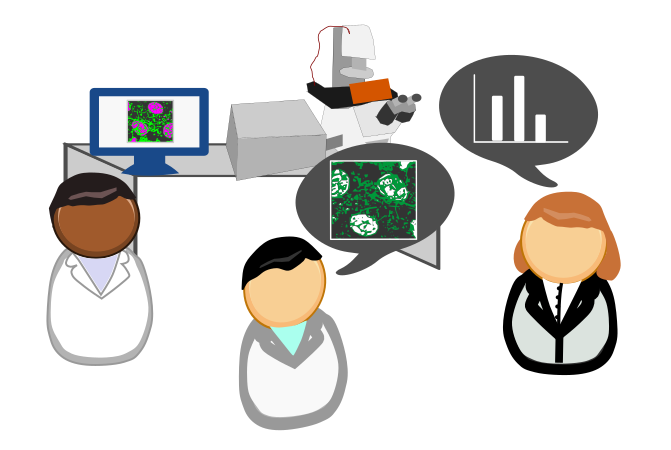
NFDI4BIOMAGE supports researchers in microscopy data handling and research data management for bioimage analysis.
Foundational and sustainability services
See how we keep everyday life running smoothly

Code Maintenance Service
Our research software engineers provide and maintain software and tools that can simplify your research life. Explore what we offer and how you can contribute.

Repositories
Repositories are like a library for images from the microscopic world. Here, researchers can safely store, organise, and share their imaging data, from single cells to complex tissues. Each dataset comes with clear details so others can understand, reuse, and build on your work. By making data accessible, our repositories help science move faster, foster collaboration, and make discoveries more reproducible.

The BioImage Archive, BIA, is a public repository for microscopy datasets linked to publications, spanning imaging from whole organisms to the molecular scale. It uses the REMBI framework to standardise metadata, improving FAIR compliance by supporting interoperability and data re-use.

The Image Data Resource, IDR, is an open repository providing well-annotated reference image datasets from published research. It comprises the cell-IDR and tissue-IDR, which host high-quality imaging data that can be easily explored and re-used.

The Electron Microscopy Public Image Archive is an open repository that stores the raw image data used to generate 3D cryo-EM maps and tomograms, as well as 3D datasets produced by volume electron microscopy and both soft and hard X-ray tomography techniques.

The Preclinical Image Dataset Repository (PIDAR) is an open resource providing metadata for preclinical imaging datasets from any modality, linked to peer-reviewed publications.
FAIR principles
What does FAIR mean?
FAIR principles describe how research data should be handled so that they are easier to use and reuse.
Findable
Data and metadata are easy to discover through search engines and repositories and have persistent identifiers.
Accessible
Data can be retrieved using standard protocols, with clear information on how they can be accessed.
Interoperable
Data use standard formats, vocabularies and metadata so they can be combined with other datasets and tools.
Reusable
Data are well described, clearly licensed and documented so they can be reused in future research.
Our goals
- Standardised image data formats
Harmonised file formats for biological imaging to ensure long-term usability and compatibility across tools and platforms. - FAIR Digital Objects for imaging data
Next-generation, cloud-ready file formats that support scalable access, processing and reuse of image data. - Improved metadata and annotation standards
Clear, consistent metadata models and user-friendly annotation tools to enhance data description and quality. - Reproducible image analysis workflows
Transparent and well-documented analysis processes that can be reliably repeated and validated.
- Interlinked image analysis tools
Better integration of commonly used analysis software to enable seamless documentation and workflow tracking. - Multimodal data integration
Linking image data with other data types from diverse experimental approaches and scientific disciplines. - Training and capacity building
Education and training across disciplines to build expertise in biological image data management. - International networking and visibility
Strong connections and recognition of NFDI within the global microscopy and imaging community.
Bioimaging has become a key driver in life and biomedical sciences, evolving into a complex big data discipline with challenges similar to other omics fields. Maximizing its potential requires making data FAIR. This webinar offers practical strategies for managing, annotating, linking, storing and sharing bioimaging data, showcasing community services that support the entire data lifecycle, from local management with OMERO to cloud-based solutions like ome.zarr, equipping researchers to get the most from their data.
How to make your data FAIR?
To make bioimaging data truly FAIR, clear guidelines and standards are essential. Together with many experts across our community, we actively contribute to developing a unified framework that supports consistent, high-quality data sharing and reuse. As bioimaging technologies continue to advance, these standards must evolve alongside them, and we are committed to helping shape that progress.
Explore the standards we help build!
Recommended Metadata for Biological Images (REMBI) standard
REMBI is a metadata standard that defines which information must be associated with a biological image so that it remains scientifically usable. We contributed to the development and publication of REMBI and have since been driving its adoption across the global community, actively shaping its uptake and impact.
Metadata, Incentives, Formats and Accessibility (MIFA) guidelines
Are a strategic framework for making research data FAIR, sustainable, shareable, and community-ready. By promoting complete, well-structured, and standardized metadata, MIFA also ensures that datasets are AI-ready, ready to power machine learning and automated analyses.
The FBbi ontology (Biological Imaging Methods Ontology)
is a formal ontology (controlled vocabulary) that provides a structured, machine-readable set of terms for biological imaging methods, especially how samples are prepared, visualized, and imaged in biomedical research. Under the auspices of the foundingGIDE project, we assumed responsibility for FBbi stewardship.
Spatial omics JSON-LD framework
is a technical standard/format specifically developed for the description, storage, and exchange of spatial omics data.
Dedicated tools will be created to systematically read, harmonize, and convert metadata from JSON and OME-XML into structured representations. This work will provide the basis for a spatial omics JSON-LD framework enabling the construction of interoperable RO-Crates.