Services

Format Development and Ambassadorship
NFDI4BIOIMAGE drives the evolution of file formats and their standardization to achieve FAIR microscopy image data. On one hand, we actively coordinate the definition and implementation of requirements of next generation file formats (NGFFs) in close exchange with the global community of developers. On the other hand, we inform and educate scientists and bioimaging staff in the adaptation of their workflows to become FAIR data champions.
What are next generation file formats and how can you benefit from them?
TRADITIONAL FILE FORMATS
Over the years, microscopy data has become larger in size and complexity and the number of file formats, many of which proprietary, is large. This consequently requires continuous efforts of the community to adapt to keep file formats interoperable and functional for analysis. And even more, traditional file formats are not ideal for the usage of cloud-based services and visualization tools.
THE MISSION
Traditional file formats thus no longer fully serve the needs to manage modern bioimage datasets in an easy, fast and efficient way. This has motivated the mission to develop community-developed file formats that satisfy both today’s technical and user needs.
NEXT-GENERATION FILE FORMATS
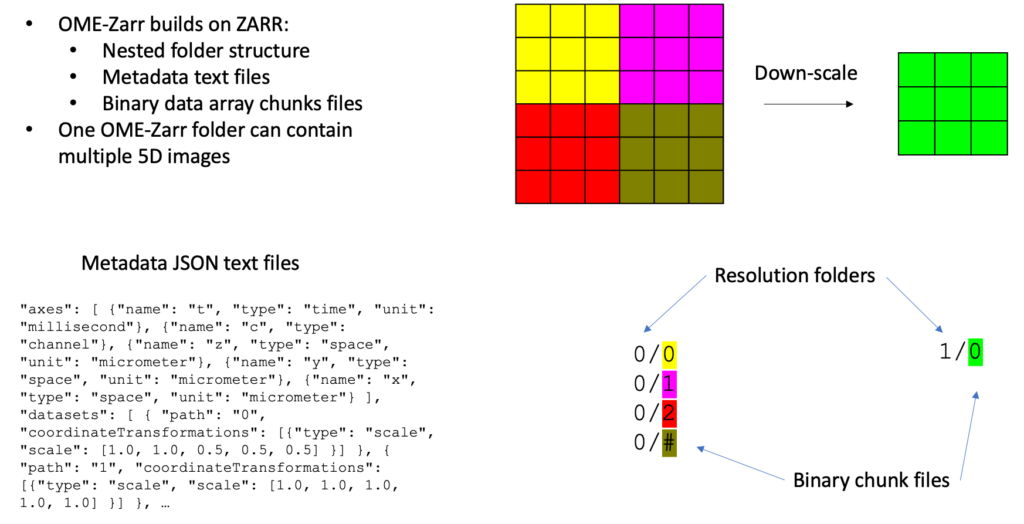
This mission bases on the concept of next-generation file formats. In those, data is organized chopped into a multitude of tiny blocks termed chunks that are each independently saved and thus also accessed on computer storage space. This architecture differs from traditional file formats being mostly a single and often large block of data required to be tediously written and read fully in order to access only small parts of it for example for inspection or analysis.
On the contrary, next-generation file formats speed up such processes by reading and writing of only those data chunks of interest, being for example specific substructures of the investigated biological specimen. Furthermore, individual chunks can be processed in parallel for fast analysis and visualization.
One prominent NGFF currently implemented in the bioimaging data universe is the format Zarr. It is currently specified based on community needs to be applicable to the majority of datasets that scientists can generate with the plethora of microscopic systems.
METADATA AND BEYOND
Bioimage data in the Zarr format is further enriched by standardized metadata using precisely defined terminology to provide experimental and technical context. This metadata is based on the Open Microscopy Environment (OME) data model. This combination of chunked data with standardized metadata drives the usage of web-based viewers for bioimage datasets such as vizarr and Neuroglancer. NFDI4BIOIMAGE research software engineers implement OME-Zarr into state-of-the-art tools and services developed in the consortium. We also contribute to the definition and implementation of so-called Research Object Crates (RO-Crates). These containers of a standardized structure allow packaging of OME-Zarr data along with accompanying metadata to sustain its larger context to guarantee machine-readability and reuse of the data.
COMMUNITY SUPPORT
NFDI4BIOIMAGE actively guides the process of bioimage format development ranging from the coordination of software development including OME-Zarr specification all the way to connecting users and developers and the organization of events such as the Open Microscopy Environment (OME) Community Meeting 2026 or hackathons. We further provide guidance on the implementation of OME-Zarr to communities, facilities and research groups via our Help Desk service, trainings and attendance on international conferences.

Can you contribute to the development of next generation file formats?
Yes, you are warmly invited to contribute. Learn how you can do this or reach out to our Help Desk for support.