Services

Research Object Crates
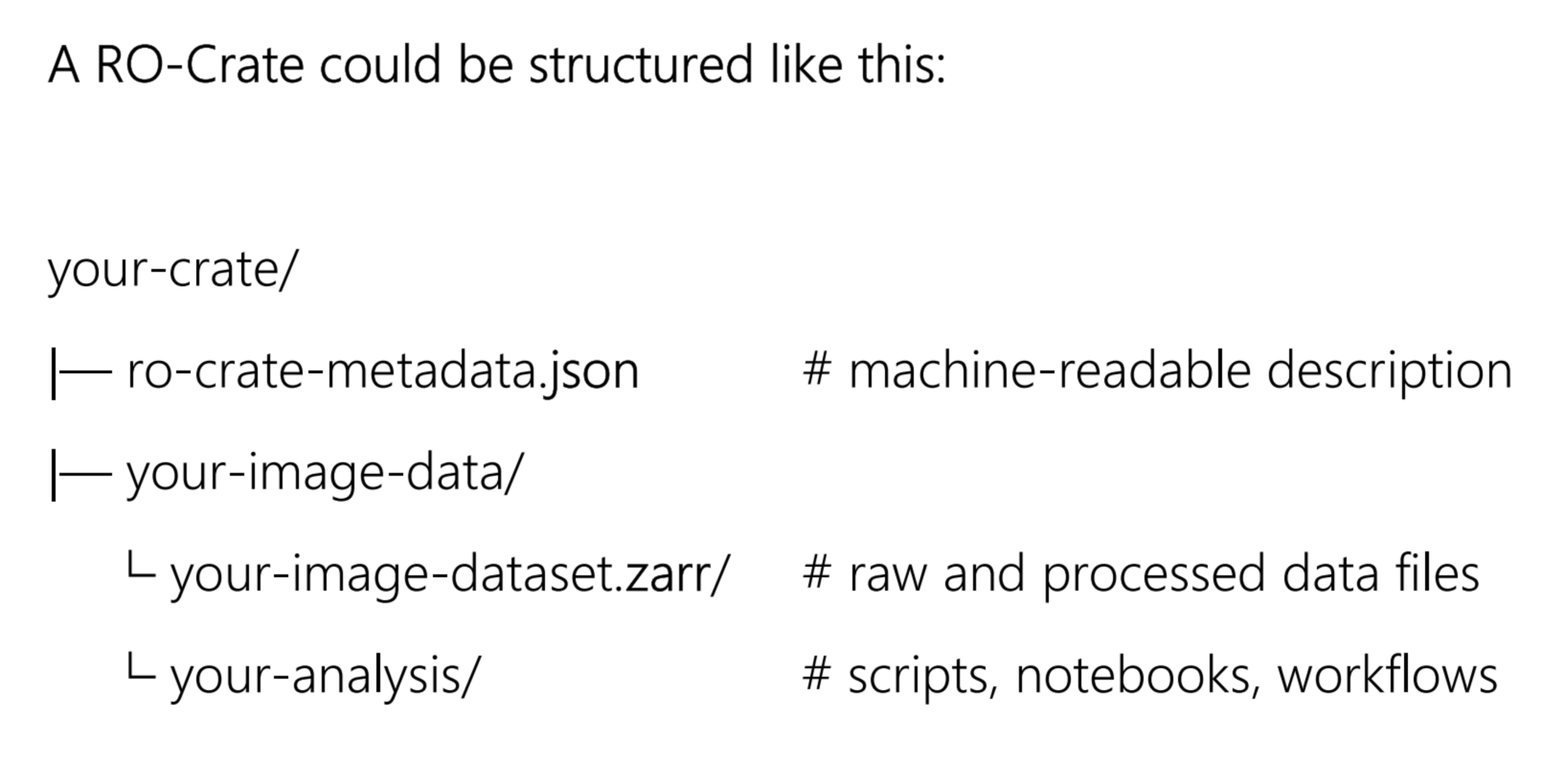
Research Object Crates, so-called RO-Crates, are self‑describing research packages that satisfy the FAIR principles out‑of‑the‑box. These ’smart boxes‘ contain the Zarr image data files as well as metadata of various kinds in a standardized and human- and machine-readable way. These crates ensure that OME-Zarr images files are tightly linked to information providing respective meaning to form complete, reusable datasets.
What is a RO-Crate and why does it matter for OME-Zarr?
A Research Object Crate (RO‑Crate) is a standardised, machine‑readable container that bundles a research dataset together with rich, structured metadata.
Think of it as a single folder that not only holds all your raw files (sequencing reads, microscopy image stacks, analysis scripts, etc.) but also a JSON‑LD description that tells what each file is, how it was produced, and how it relates to the other files.
This container can be a real physical folder, but it can also be a collection of links to storage locations.
How do RO-Crates tackle common pain points in life science research?
- All files live together in one crate folder instead of being scattered across many directories or drives.
- A central ‚ro-crate-metadata.json‘ file stores curated, schema‑based metadata including for example sample IDs, instrument settings, protocols, software versions instead of missing, inconsistent or hidden metadata.
- Explicit relationships (such as ’sample‑X was measured by instrument‑Y and processed with script‑Z‘) are encoded as so-called resource description framework (RDF) triples instead of tedious tracing of provenance (sample → instrument → analysis).
- The crate is already FAIR‑compliant and can be uploaded directly to Zenodo, the Open Science Framework (OSF) or a FAIR‑Data‑Point instead of extra documentation required to share data with journals, repositories, or collaborators requires extra documentation.
- FAIR‑readiness – Metadata is findable and interoperable without extra effort.
- Provenance traceability – Links between samples, instruments and analysis steps are precisely defined.
- Re‑usability – Colleagues can re‑run the exact analysis because scripts, parameters and software versions travel with the data.
- Portability – The crate is just a folder and thus easy to archive, copy, or version‑control.
- Machine‑readability – Search engines, data catalogs, and AI tools can automatically index and reason over the contents.