NFDI4BIOIMAGE News
25.02.2025
Workshop for non-imaging stakeholders at the E-Science Tage in Heidelberg
NFDI4BIOIMAGE, in collaboration with I3D:bio, offers a workshop at the E-Science Tage dedicated to research data management in microscopy and image analysis. The workshop is directed at non-bioimaging experts at unviersities and research institutions.
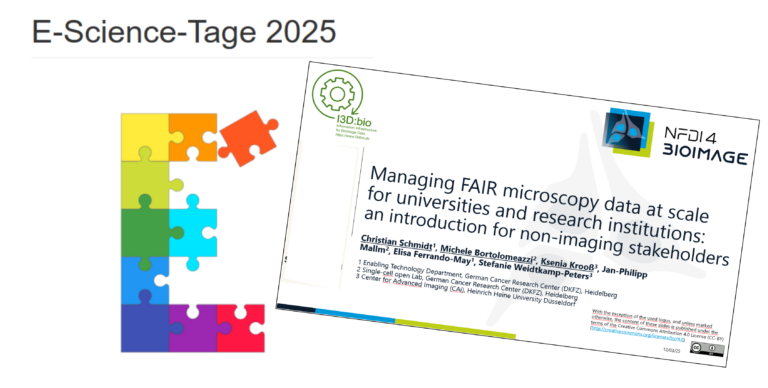
The E-Science Tage 2025 take place in Heidelberg from March 12th-14th. NFDI4BIOIMAGE and I3D:bio will provide a joint workshop about microscopy data management addressing non-bioimaging stakeholders at universities and research institutions.
Full abstract:
Effective Research Data Management (RDM) requires collaboration between infrastructure providers, support units, and domain-specific experts across scientific disciplines. Microscopy, or bioimaging, is a widely used technology at universities and research institutions, generating large, multi-dimensional datasets. Scientists now routinely produce microscopy data using advanced imaging modalities, often through centrally-provided instruments maintained by core facilities.
Bioimaging data management presents unique challenges: files are often large (e.g., 15+ GB for whole slide images), come in various proprietary formats, and are accessed frequently for viewing as well as for complex image processing and analysis workflows. Collaboration between experimenters, clinicians, group leaders, core facility staff, and image analysts adds to the complexity, increasing the risk of data fragmentation and metadata loss.
The DFG-funded project I3D:bio and the consortium NFDI4BIOIMAGE, part of Germany’s National Research Data Infrastructure (NFDI), are addressing these challenges by developing solutions and best practices for managing large, complex microscopy datasets. This workshop introduces the challenges of bioimaging RDM to institutional support personnel, including, for example, library staff, IT departments, and data stewards. Participants will explore the bioimaging RDM system OMERO, and apply structured metadata annotation and object-oriented data organization to a simple training dataset. OMERO offers centralized, secure access to data, allowing collaboration and reducing the data fragementation risk. Moreover, participants will experience the benefits of OME-Zarr, a chunked open file format designed for FAIR data sharing and remote access. OME-Zarr enables streaming of large, N-dimensional array-typed data over the Internet without the need to download whole files. An expanding toolbox for leveraging OME-Zarr for bioimaging data renders this file type a promising candidate for a standard file format suitable for use in FAIR Digital Object (FDO) implementations for microscopy data. OME-Zarr has become a pillar for imaging data sharing in two bioimaging-specific data repositories, i.e., the Image Data Resource (IDR) and the BioImage Archive (BIA). The team of Data Stewards from both abovenmentioned projects help researchers and research support staff to manage und publish bioimaging data.
By the end of the workshop, participants will have gained hands-on experience with bioimaging data and will be aware of support resources like the NFDI4BIOIMAGE Help Desk for addressing specific local use cases. Our goal is to promote collaboration across disciplines to effectively manage complex bioimaging data in compliance with the FAIR principles.
For more information about the E-Science Tage, please visit: https://e-science-tage.de/