FAIR principles
What does FAIR mean?
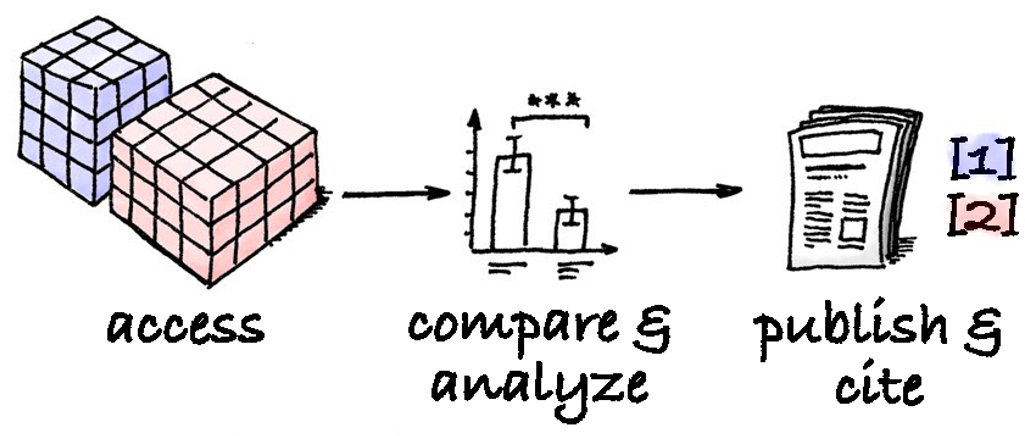
FAIR principles describe how research data should be handled so that they are easier to use and reuse.
Findable
Data and metadata are easy to discover through search engines and repositories and have persistent identifiers.
Accessible
Data can be retrieved using standard protocols, with clear information on how they can be accessed.
Interoperable
Data use standard formats, vocabularies and metadata so they can be combined with other datasets and tools.
Reusable
Data are well described, clearly licensed and documented so they can be reused in future research.
Our goals
- Standardised image data formats
Harmonised file formats for biological imaging to ensure long-term usability and compatibility across tools and platforms. - FAIR Digital Objects for imaging data
Next-generation, cloud-ready file formats that support scalable access, processing and reuse of image data. - Improved metadata and annotation standards
Clear, consistent metadata models and user-friendly annotation tools to enhance data description and quality. - Reproducible image analysis workflows
Transparent and well-documented analysis processes that can be reliably repeated and validated.
- Interlinked image analysis tools
Better integration of commonly used analysis software to enable seamless documentation and workflow tracking. - Multimodal data integration
Linking image data with other data types from diverse experimental approaches and scientific disciplines. - Training and capacity building
Education and training across disciplines to build expertise in biological image data management. - International networking and visibility
Strong connections and recognition of NFDI within the global microscopy and imaging community.
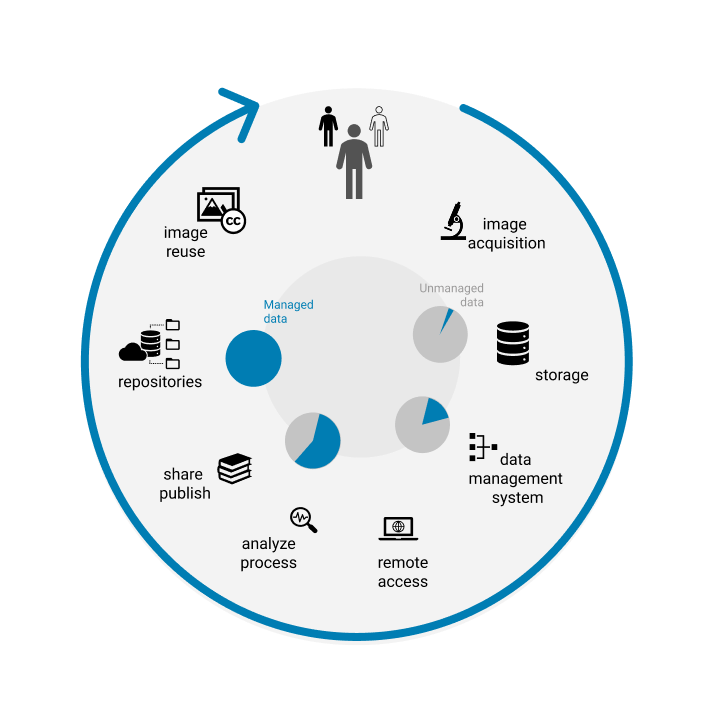
Bioimaging has become a key driver in life and biomedical sciences, evolving into a complex big data discipline with challenges similar to other omics fields. Maximizing its potential requires making data FAIR. This webinar offers practical strategies for managing, annotating, linking, storing and sharing bioimaging data, showcasing community services that support the entire data lifecycle, from local management with OMERO to cloud-based solutions like ome.zarr, equipping researchers to get the most from their data.
How to make your data FAIR?
To make bioimaging data truly FAIR, clear guidelines and standards are essential. Together with many experts across our community, we actively contribute to developing a unified framework that supports consistent, high-quality data sharing and reuse. As bioimaging technologies continue to advance, these standards must evolve alongside them, and we are committed to helping shape that progress.
Explore the standards we help build!
Capacitate researchers for FAIR image data management
Help Desk / data deposition support
Training Material Hub
Playground & Training Servers
Reproducible image analysis workflows
Galaxy Tool integration
JupyterHub BioImaging
JIPipe
Standardization of the "bioimage data" type
FAIR Image Objects
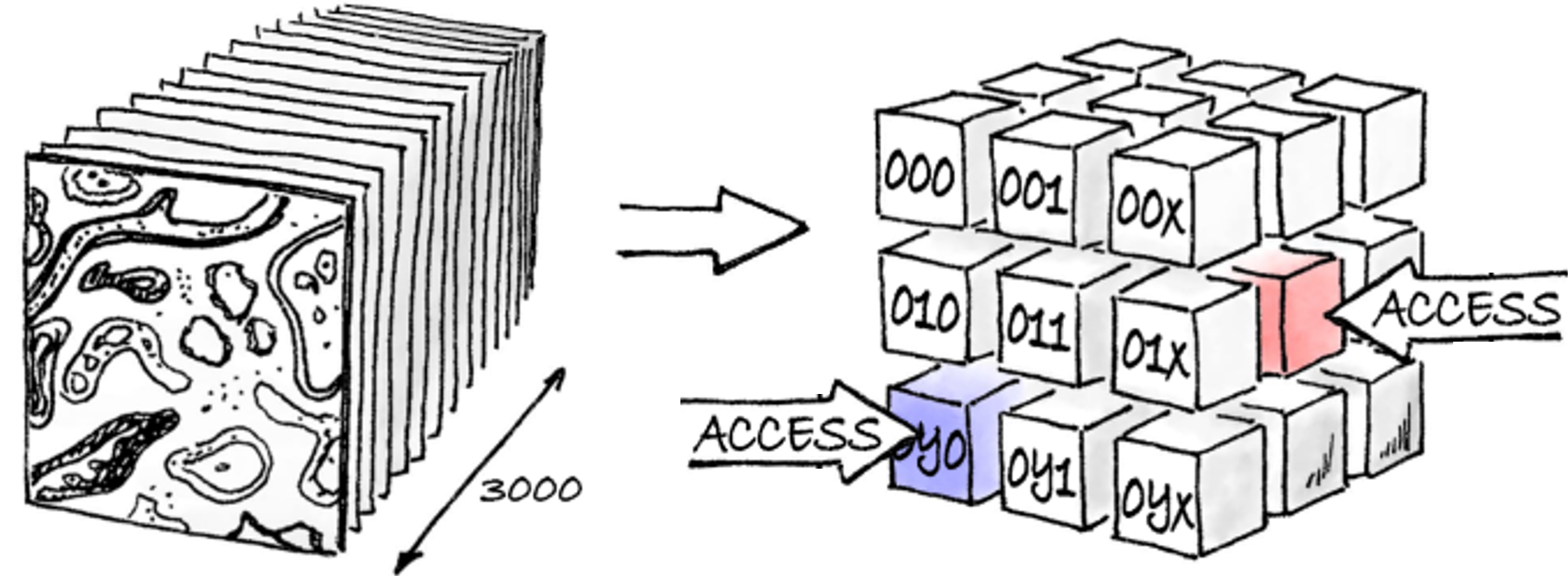
Distributed, cloud-ready, parallelizable format
Scalable infrastructure
S3 File Storage Service
Remote Analysis Desktops (Desktops as a Service)
Capacitate researchers for FAIR image data management
Help Desk / data deposition support
Training Material Hub
Playground & Training Servers
Galaxy Tool integration
JupyterHub BioImaging
JIPipe
Reproducible image analysis workflows
Standardization of the "bioimage data" type
FAIR Image Objects
Distributed, cloud-ready, parallelizable format
S3 File Storage Service
Remote Analysis Desktops (Desktops as a Service)
Scalable infrastructure
Standardization of the "bioimage data" type
FAIR Image Objects
Distributed, cloud-ready, parallelizable format
Scalable infrastructure
S3 File Storage Service
Remote Analysis Desktops (Desktops as a Service)
Reproducible image analysis workflows
Galaxy Tool integration
JupyterHub BioImaging
JIPipe
Capacitate researchers for FAIR image data management
Help Desk / data deposition support
Training Material Hub
Playground & Training Servers
Recommended Metadata for Biological Images (REMBI) standard
REMBI is a metadata standard that defines which information must be associated with a biological image so that it remains scientifically usable. We contributed to the development and publication of REMBI and have since been driving its adoption across the global community, actively shaping its uptake and impact.
Metadata, Incentives, Formats and Accessibility (MIFA) guidelines
MIFA is a strategic framework for making research data FAIR, sustainable, shareable, and community-ready. By promoting complete, well-structured, and standardized metadata, MIFA also ensures that datasets are AI-ready, ready to power machine learning and automated analyses.
RO-Crate
or “Research Object Crates”, are self‑describing research packages that satisfy the FAIR principles out‑of‑the‑box. These ‘smart boxes’ contain the Zarr image data files as well as metadata of various kinds in a standardized and human- and machine-readable way. These crates ensure that OME-Zarr images files are tightly linked to information providing respective meaning to form complete, reusable datasets.
The FBbi ontology (Biological Imaging Methods Ontology)
is a formal ontology (controlled vocabulary) that provides a structured, machine-readable set of terms for biological imaging methods, especially how samples are prepared, visualized, and imaged in biomedical research. Under the auspices of the foundingGIDE project, we assumed responsibility for FBbi stewardship.
Spatial omics JSON-LD framework
is a technical standard/format specifically developed for the description, storage, and exchange of spatial omics data.
Dedicated tools will be created to systematically read, harmonize, and convert metadata from JSON and OME-XML into structured representations. This work will provide the basis for a spatial omics JSON-LD framework enabling the construction of interoperable RO-Crates.
Repositories
Repositories are like a library for images from the microscopic world. Here, researchers can safely store, organise, and share their imaging data, from single cells to complex tissues. Each dataset comes with clear details so others can understand, reuse, and build on your work. By making data accessible, our repositories help science move faster, foster collaboration, and make discoveries more reproducible.
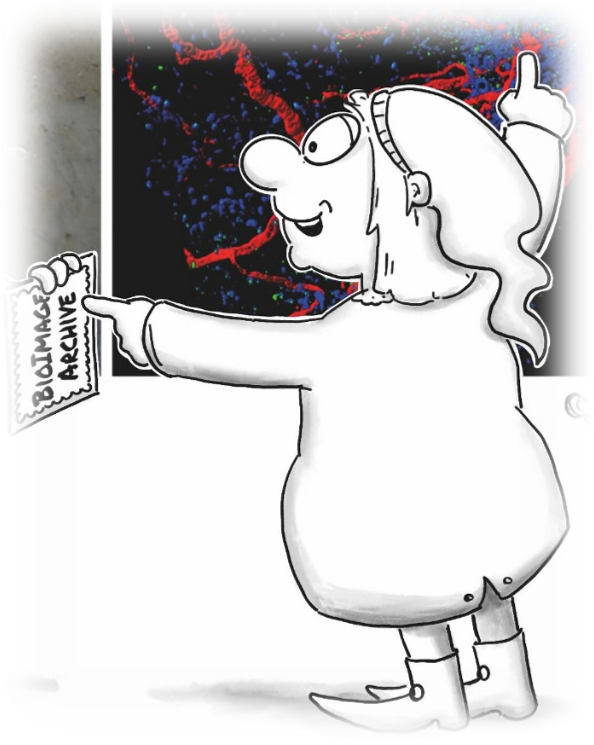
The BioImage Archive, BIA, is a public repository for microscopy datasets linked to publications, spanning imaging from whole organisms to the molecular scale. It uses the REMBI framework to standardise metadata, improving FAIR compliance by supporting interoperability and data re-use.
The Image Data Resource, IDR, is an open repository providing well-annotated reference image datasets from published research. It comprises the cell-IDR and tissue-IDR, which host high-quality imaging data that can be easily explored and re-used.
The Electron Microscopy Public Image Archive is an open repository that stores the raw image data used to generate 3D cryo-EM maps and tomograms, as well as 3D datasets produced by volume electron microscopy and both soft and hard X-ray tomography techniques.
The Preclinical Image Dataset Repository (PIDAR) is an open resource providing metadata for preclinical imaging datasets from any modality, linked to peer-reviewed publications.
FAIR Data Champions
Be A Champion: Put FAIR into practice
FAIR data management does not emerge from infrastructure alone. It emerges where people take responsibility.
At NFDI4BIOIMAGE, we understand FAIR Data Champions as active members of the bioimaging community who make the FAIR principles visible, actionable, and operational in everyday research practice. To this end, we put emphasis on open, cloud-ready file formats such as OME-Zarr, and metadata in compliance with community-established standards, most notably REMBI, the REcommended Metadata for Biological Imaging.
Want to become a FAIR Data Champions yourself? Reach out, learn how to manage bioimaging data in compliance with the FAIR principles, and lead by example. We support this engagement through:
- Training materials and workshops
- Helpdesk and Data Stewardship support
- Community calls
- Hackathons
- Visibility through our communication channels
FAIR Data Champions promote and advocate for better research data management and support implementing FAIR in laboratories, core facilities, collaborative research networks, training programs, and international initiatives. They act as multipliers between: Research practice and infrastructure, community needs and standardization as well as local implementation and national strategy.
Who are our FAIR Data Champions?
A FAIR Data Champion is not a full-time postion. It is a role that anyone can take on. At NFDI4BIOIMAGE, Task Area Leaders, the networking coordinator, our Data Stewards, and many colleagues from our community act as FAIR Data Champions on regular occasions:
Making FAIR Visible at Conferences
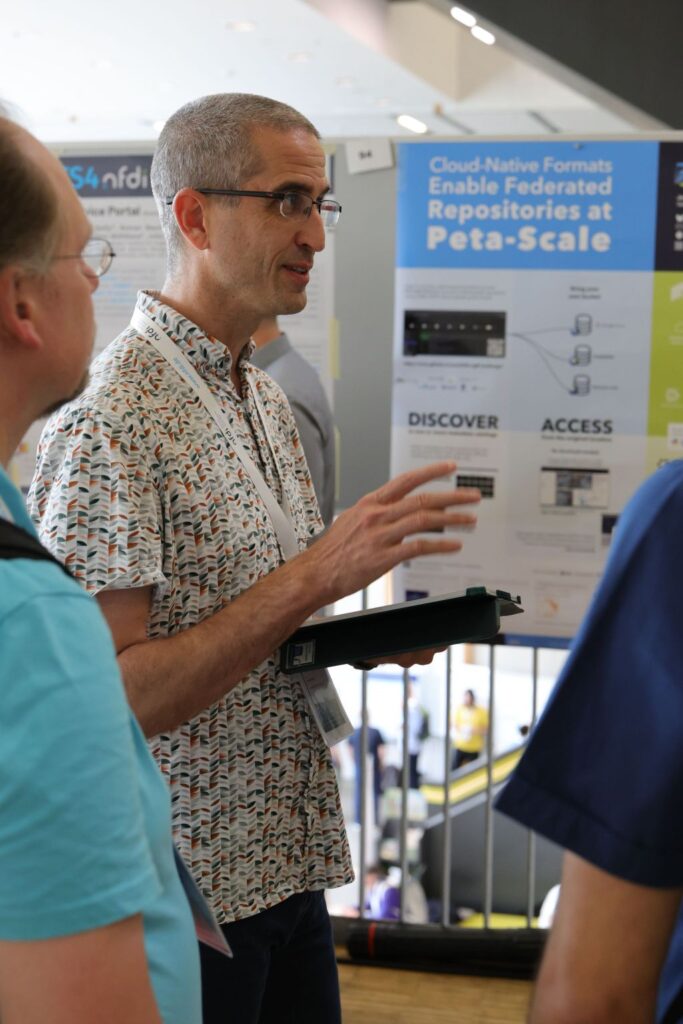
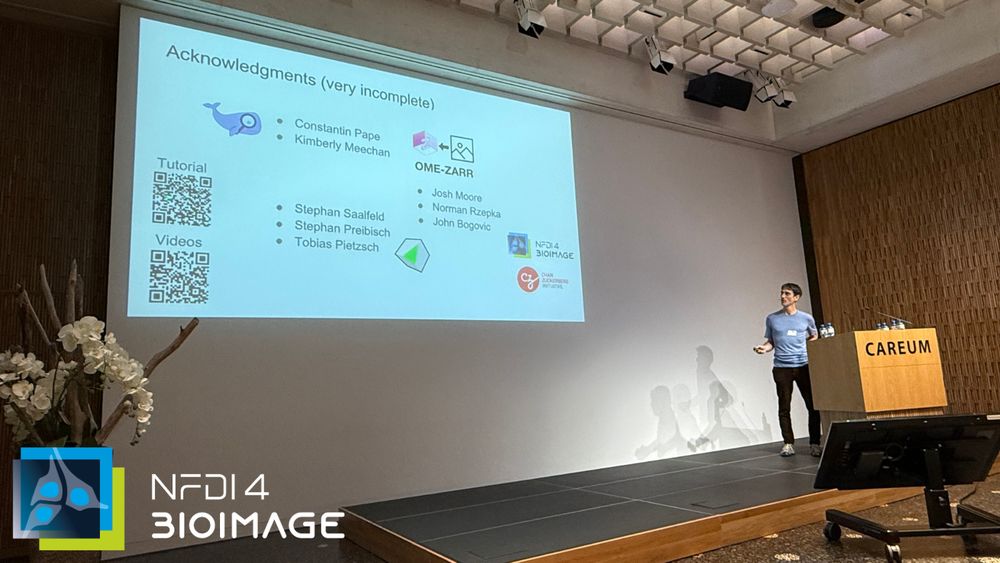
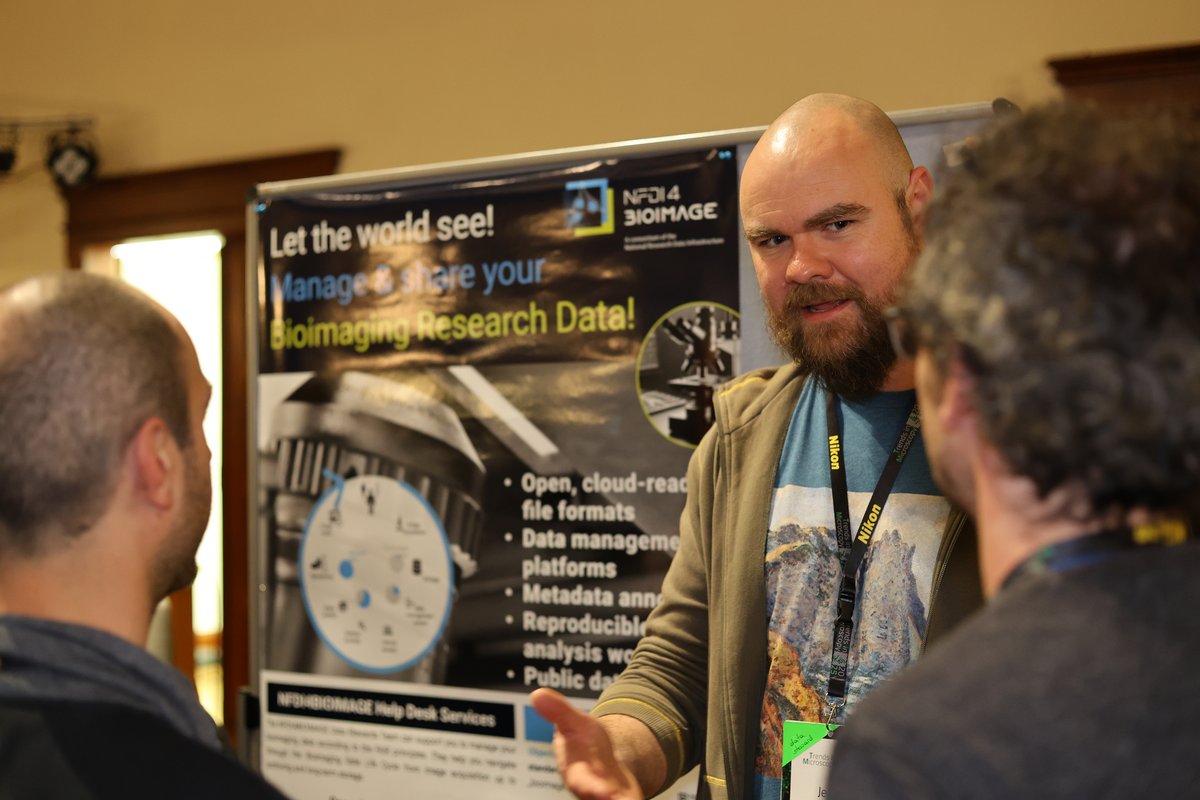
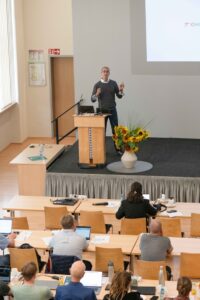
Whether at Trends in Microscopy, the GBM Compact Symposium, ELMI, the EOSC Symposium (see image), or other specialized events, members of NFDI4BIOIMAGE regularly act as ambassadors for structured bioimage data management.
Typical activities include:
- Workshops such as “From Acquisition to Publication”
- Introductions to OMERO, BioImage Archive, and structured metadata
- Discussions on OME-Zarr and cloud-based workflows
- Consultation on data publication strategies
Here, we promote tools and best practices to adopt FAIR in the own every-day research work.
Advancing FAIR through standardization
FAIR Data Champions may also be directly engaged in international standardization efforts, driving forward the tools and formats that enable FAIR bioimage data handling, including:
- OME-Zarr / NGFF community calls
- Hackathons focused on advancing metadata standards (e.g., de.NBI BioHackathon)
- Implementation of RO-Crate in analysis workflows
- Contributions to NFDI-wide metadata recommendations
Our FAIR Data Champions bring requirements from biological imaging directly into technical specifications while ensuring that emerging standards are fed back into the community.
Embedding FAIR in everyday practice
FAIR Data Champions also operate at the local level by:
- Integrating metadata annotation into core facility processes
- Introducing OMERO into research groups
- Supporting Data Management Plan development
- Publishing datasets with DOIs
- Developing reproducible image analysis workflows
Many of these initiatives originate from concrete research projects and are later shared as best practices. Find help to manage your data in a FAIR way.
Enabling FAIR through training and early-career education
Many FAIR Data Champions are also educators who:
- Integrate RDM training into training curricula (e.g., for PhD students)
- Offer hands-on workshops on FAIR bioimage analysis
- Demonstrate how to use tools and platforms such as OMERO.
- Train trainers to act as multipliers
In doing so, they equip the next generation of researchers with robust data management practices from the outset of their careers.
Promoting cross-domain integration of FAIR workflows
FAIR Data Champions do not operate within disciplinary silos. They actively connect bioimaging workflows with broader research data infrastructures across domains.
In cross-consortial and cross-disciplinary contexts, such as collaborations with FAIRagro, NFDI4Health, DataPLANT, or other NFDI initiatives, FAIR Data Champions:
- Present bioimaging-specific FAIR solutions to non-imaging communities
- Align image data workflows with cross-domain metadata frameworks
- Contribute imaging use cases to domain-agnostic infrastructure discussions
- Integrate bioimage analysis tools into broader data ecosystems
- Foster interoperability between repositories, platforms, and standards
At events such as the Gatersleben Conference and other domain-spanning meetings, FAIR workflows for bioimaging are positioned within the wider landscape of research data management.